

Residents practicing testicular torsion detection using a new model created by the Children’s Pediatric Simulation Center
Testicular torsion is a serious medical emergency that requires immediate surgical intervention. It occurs when the spermatic cord twists, cutting off blood flow to the testicle. If not treated promptly, the condition can lead to permanent damage or loss of the affected testicle.
“Time is testicle,” said Carmen Tong, D.O., a pediatric urologist at Children’s of Alabama. “Pretty much every minute counts when it comes to testicular torsion.” Indeed, the so-called “golden window” to salvage testicular function after symptom onset is between four and eight hours. Any longer not only affects long-term testicular function but increases the risk of orchiectomy, or the removal of one or both testicles. “That can be devastating,” Tong added.
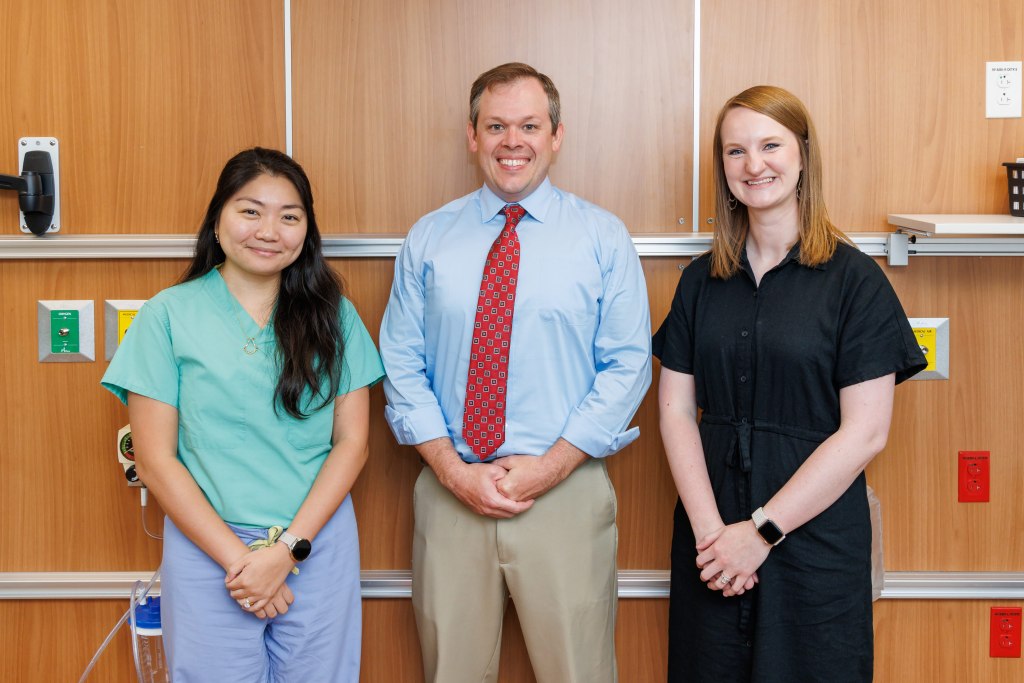
So prompt diagnosis is crucial. Yet the condition may present with vague symptoms such as abdominal pain and nausea. To improve diagnosis, Tong turned to pediatric intensivist Nick Rockwell, M.D., and advanced nurse educator Autumn Layton, MSN, RN, in the hospital’s Pediatric Simulation Center. Together, they created a testicular torsion model that provides hands-on training for residents.
The initiative came about after a teenaged boy’s torsion was missed. That begged the question: “Is there a way we can work with our trainees to give them a better understanding of something that’s a rare event, but when it happens, is a high-stakes situation,” Rockwell said.
Rockwell, Layton and their team used Play-Doh-covered Styrofoam balls to simulate a torsed testicle, while a stress ball represents a normal testicle. These are enclosed in balloons to mimic scrotal skin and attached to a mannequin. Residents can then practice palpating the model to distinguish between normal and torsed testicles, providing a “full, immersive experience,” Rockwell said.
The students are told the mannequin is a 15-year-old boy admitted the night before for abdominal pain that is getting worse. Rockwell “plays” the patient, responding to questions. He can also adjust the mannequin’s vital signs, such as increasing heart rate if the trainees do something painful during the exam.
Next up for the training is a series of mannequins: one is normal while three others depict the disease at different stages. This helps learners distinguish which testicle is torsed, or if the testicle is inflamed (epididymitis). Through this exercise, trainees learn the Testicular Workup for Ischemia and Suspected Torsion (TWIST) score, which identifies children at risk of testicular torsion. The higher the score, the more urgent the need for immediate treatment.
The response to the training been overwhelmingly positive, Tong said. In addition, “what’s super impressive about this model is that it’s easily replicable. So once we publish this, other institutions can take what we did and create the same model. It doesn’t cost thousands of dollars.”

No Comments