

The Children’s of Alabama Sleep Disorders Center is taking a multifaceted approach to pediatric sleep disorders. (Stock photo)
Pediatric sleep disorders affect 25-40% of children and adolescents in the U.S. However, the incidence is increasing, said Brad Troxler, M.D., who directs the Children’s of Alabama Sleep Disorders Center. The reasons for the increase are multi-factorial, Troxler said, but the problems are exacerbated by expanding screen time, which affects the quality of sleep; childhood obesity, which increases the risk of obstructive sleep apnea and other sleep disorders; and the after-effects of the pandemic, when sleep schedules were disrupted. Troxler and his team are addressing the increase through innovation, research and training.
About the center
The Children’s Sleep Disorders Center is the only multidisciplinary pediatric sleep disorders program in Alabama and one of just a handful of in the country. It features a 12-bed unit, in which the team performs about 2,000 overnight sleep studies and up to 100 daytime studies each year. Most patients are seen for insomnia, daytime sleepiness and snoring, as well as chronic conditions like sleep apnea, narcolepsy, idiopathic hypersomnia and periodic limb movement disorders.

The pediatric sleep program differs significantly from adult programs in its approach, Troxler said. “Certainly, a pediatric sleep program is going to be much more patient and family centered and more holistic than what you might see in an adult sleep center,” he added. In addition, it requires more technicians and nurses—usually one for every two patients—to make children, especially those with autism or other developmental disabilities, feel comfortable with the electrodes and other equipment required for a sleep study.
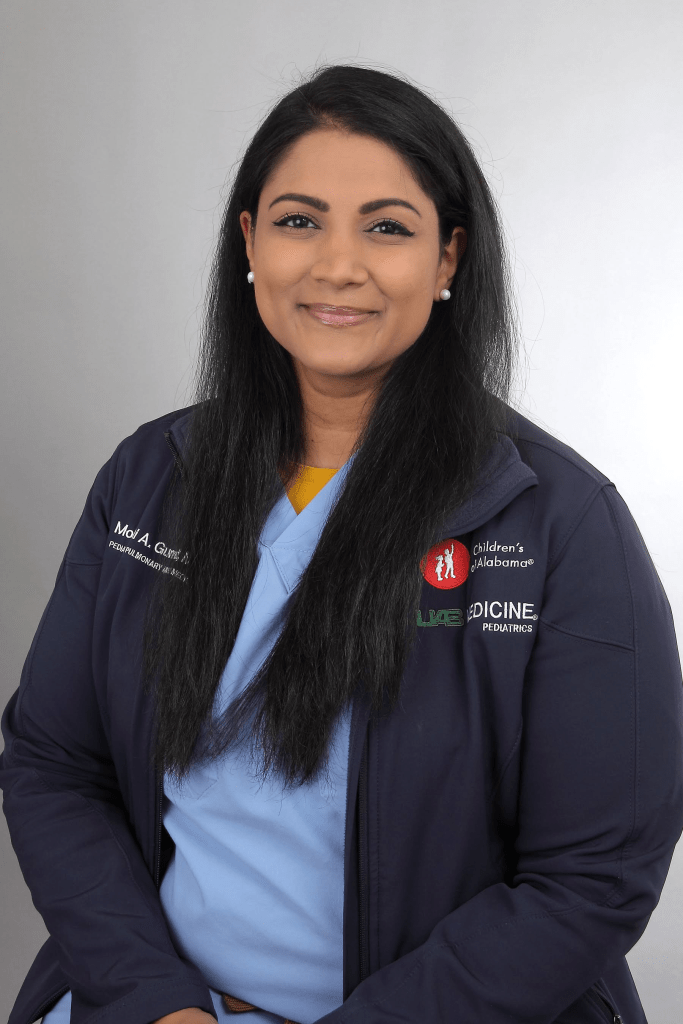
“Pediatric patients require lengthier visits,” sleep specialist Mohini Gunnett, M.D., said. “And there’s definitely a need for more specialized protocols for the complex scenarios children can present with.” The team also manages many comorbidities associated with sleep disorders, particularly pulmonary conditions.
Innovation
“We are always trying to create and improve on innovative models of care,” said Gunnett, who’s also an assistant professor in the Division of Pulmonary and Sleep Medicine. For instance, she recently worked with pediatric otolaryngologist Philip Rosen, M.D., to implant the first pediatric patient with an upper airway stimulation device to assist with management of sleep apnea.
This nerve stimulator device, which is currently approved for patients with Down syndrome, works by producing gentle pulses to the nerve that controls airway muscles and tongue movement, helping keep the airway open and the tongue protruded forward so breathing is more comfortable during sleep.
“We are excited to see how this intervention can help manage sleep apnea in a population that often struggles to achieve control of their sleep apnea with conventional positive airway pressure therapy alone,” Gunnett said.
Research
Research is also becoming more of a focus in the program. Anis Nourani, M.D., an assistant professor in the Division of Pediatric Pulmonary and Sleep Medicine, is creating a database that can be used for research and quality improvement projects, and the team recently received multiple grants to study behavioral modifications for certain sleep disorders. Several other grants are pending. “The research component is growing and adding to the fun of the job,” Gunnett said. “Hopefully, it will lead to even better patient care improvement and growth in our group.”
Training
Nourani also serves as the director of the Sleep Medicine Fellowship Program, which is one of the few programs of its kind in the country, training a pediatric and an adult specialist each year. Nourani says the fellowship is crucial given a significant shortage of pediatric sleep specialists nationwide. Currently, there are only about 420 pediatric board-certified sleep medicine specialists in the U.S., or just 0.51 sleep physicians for every 100,000 children.

To address this gap, the team at Children’s is working to incorporate more sleep education into the curriculum for medical students and residents, hoping to spark interest in the field and encourage more trainees to pursue sleep medicine fellowships. Students are also now rotating through the center. And, as more research emerges about the complex relationship between sleep and health, more practitioners are becoming interested in the field, Nourani said, including those from primary care, pulmonary medicine, neurology and anesthesiology.
The basics
Despite new technology and innovative treatments for sleep disorders, the basics for getting a good night’s sleep remain the same: “Creating a consistent bedtime routine that limits screen time and does not vary widely from day to day,” Troxler said.

No Comments