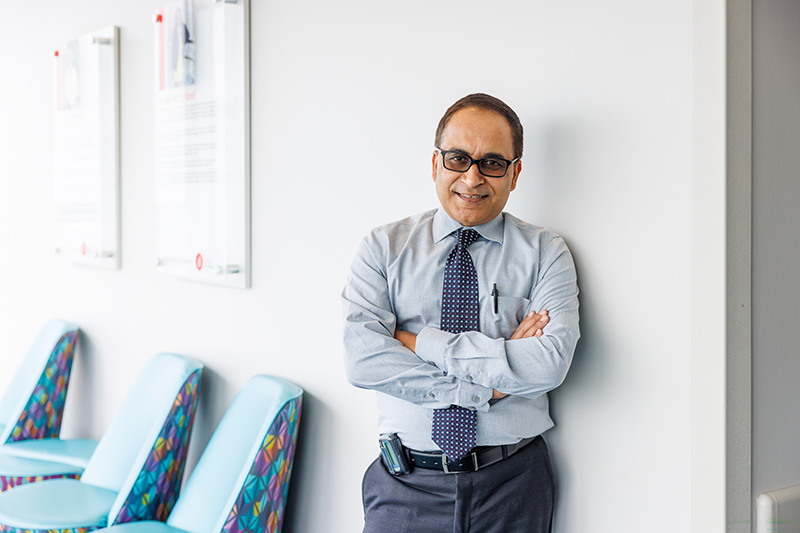
Since joining Children’s in 2019, Girish Dhall, M.D., has helped the hospital become a national leader for clinical trials.
When Girish Dhall, M.D., arrived at Children’s of Alabama in 2019, he inherited a division with a plethora of strengths: great facilities, compassionate physicians and a robust clinical trials program. He knew he was somewhere special. Still, he knew it could be better—a national destination center for research and clinical trials. That became his vision. As he began his new role as director of the Division of Hematology, Oncology, and the Blood and Marrow Transplantation Program, he immediately started work on one of his first objectives—expanding the clinical trials program.
Prior to Dhall’s arrival, the hospital offered many clinical trials through the Children’s Oncology Group—the largest consortium in the U.S.—for children who were newly diagnosed with cancer. For patients who had relapsed or had experienced progression of their disease, however, the options were limited. Dhall knew the hospital would need to join more consortia—groups of hospitals that collaborate to offer large-scale clinical trials that might be impossible for a single institution. For Children’s, joining more consortia would give patients access to a wider array of clinical trials.
Dhall and his team of experts began applying for membership in various consortia. Five years later, Children’s has more than doubled the number in which it is enrolled. “What that did,” Dhall said, “is gave us access, suddenly, to a large number of clinical trials for this group of patients that we didn’t have great options for.”
The benefits for Alabama and beyond
For children in Alabama with cancer, the new clinical trials are game-changing. Previously, patients may have had to travel out of state or even to another part of the country to access the trials they needed. “And that was only accessible for some families who have the resources to do it,” Dhall said. “For a large number of our patients, that was not possible.”
Now, those children have access to the same clinical trials without having to leave the state. That’s big even beyond Alabama. Dhall says patients come from Mississippi, Louisiana, North Florida and other parts of the Gulf Coast region for the trials. The hospital even gets referrals from other countries. “The impact of having access to these clinical trials is great for this region,” he said. “It’s a good challenge to have to accommodate all those patients and provide access. So I think it’s been great not just locally, but regionally as well.”
Jaxan’s story
For Jaxan Jernigan and his family, the new trials are already paying off. When he was 6 years old, he began experiencing headaches and seizures. At the local hospital in Pensacola, Florida, doctors discovered a large brain tumor. After a 14-hour surgery, they determined it was a high-grade aggressive tumor called a CNS embryonal tumor.
At Children’s, Dhall was leading the Head Start 4 clinical trial—one of the new trials added through his expansion efforts. Jaxan’s parents agreed to have him receive therapy on this trial, and he went through several rounds of intensive chemotherapy and three stem cell transplants followed by 30 days of brain and spinal irradiation. Nearly eight months later, Jaxan was considered to be in remission. Today, he’s back to an active life. “We owe so much of that to Dr. Dhall and the entire staff at Children’s,” Jaxan’s dad, Craig, said. “It was obvious that everyone at Children’s genuinely cares, and that’s truly inspiring.”
Head Start trial
The Head Start trial is just one example of the opportunities Dhall brought. It opened in 1990 and is currently in its fourth iteration, now involving more than 60 institutions across the U.S., Canada, Australia, New Zealand and Europe. Dhall is a national co-chair of the study.
“The idea behind Head Start is to give high-dose or intensive chemotherapy up front so that we can either avoid whole-brain irradiation completely for these infants and young children or be able to give really reduced dose and volume of irradiation,” Dhall said, “and keeping in mind that we want to maintain the survival that we see with irradiation, but with much less long-term side effects.”
Just in the last couple of years, researchers involved in Head Start have seen big results. At an international conference in Philadelphia in 2024, Dhall reported on a group of patients with SHH-activated medulloblastoma, a highly malignant brain tumor. Using the Head Start treatment strategy, doctors were able to cure more than 95% of the patients without using radiation therapy to the brain, Dhall said. “So that actually moves the field significantly forward,” he added.
Other trials
Treating brain tumors is just one of the program’s focal points. The hospital also has teams that specialize in blood disorders, leukemia and lymphoma, solid tumors such as kidney and liver cancer and more.
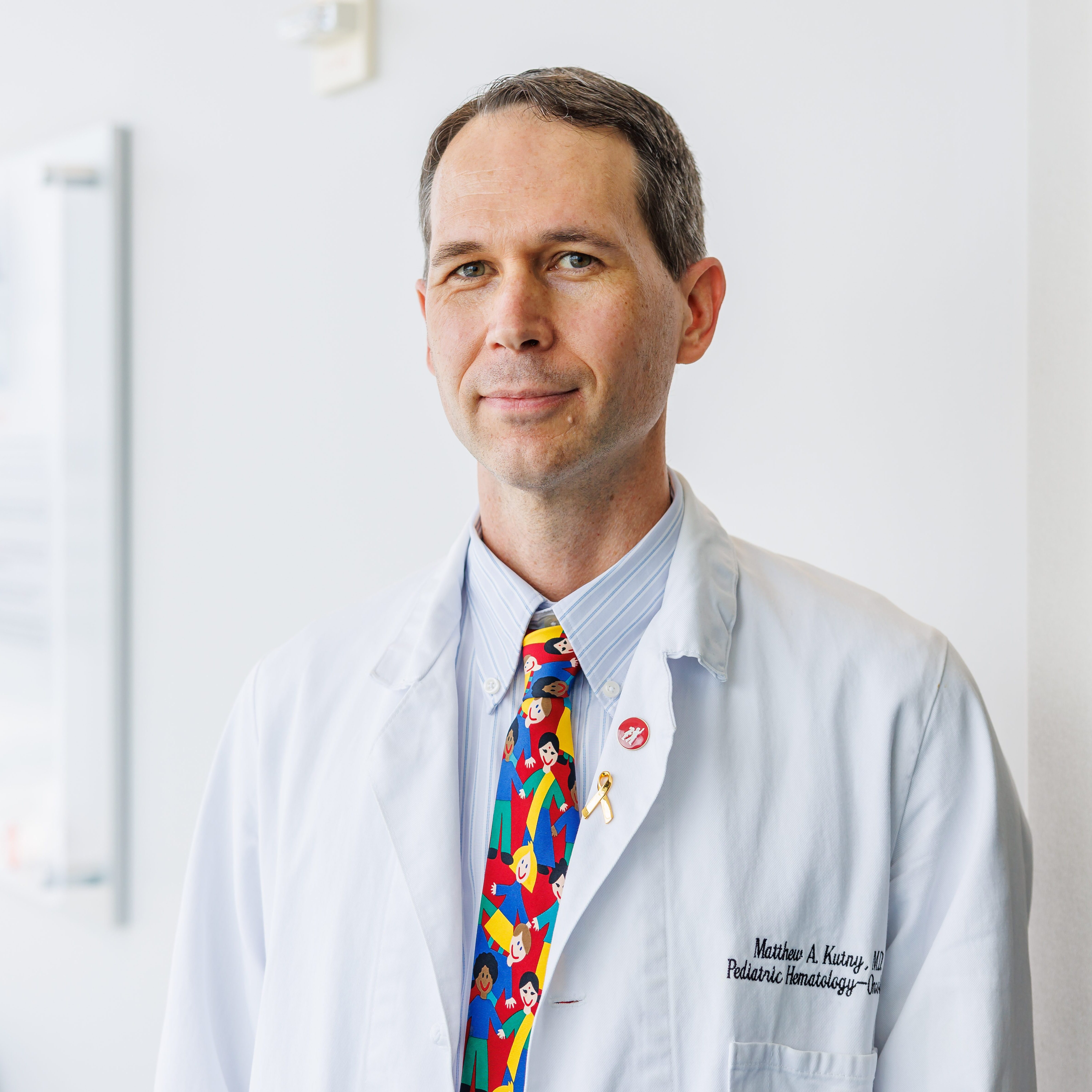
“So you can imagine the breadth of the trials that are involved,” said Matthew Kutny, M.D., director of the Children’s Pediatric Clinical Trials Office—a role Dhall held until he turned it over to Kutny in 2022. Since then, Kutny has continued to build the program and seen a lot of exciting developments, including the move toward targeted therapy and immunotherapy. These can allow patients, when possible, to avoid chemotherapy, which can damage healthy cells in the process of killing cancer cells. Targeted therapies zero in on the changes that occurred in the cells to make them cancerous. Kutny says these treatments have been successful against leukemia and solid tumors. Immunotherapy, on the other hand, engages a child’s immune system to fight off cancer as if it were an infection. “There are several exciting immunotherapy research projects that we’ve been able to participate in and lead here in Alabama,” Kutny said.
Children’s also performs bone marrow and stem cell transplants, which have proven life-saving for many patients. The stem cell transplant team offers CAR T-cell therapy, in which a patient’s own immune cells are taken into a lab and programmed to fight their cancer.
“We’ve been able to offer that to some of the children of Alabama here who otherwise would have had to go through those very intensive treatments with chemotherapy and stem cell transplant,” Kutny said. “And they’ve been able to respond to these new cellular therapies, and it’s really amazing to see how well they tolerate the treatments, and it’s been a great success in our era of oncology.”
A promising future
Because of the efforts of Dhall and Kutny, Children’s now has one of the nation’s largest clinical trial programs in pediatric oncology and hematology. “I’ve been really blessed to be a part of this team that has seen extreme growth over the last five years,” Kutny said.
More growth may be coming. Kutny says the team is actively expanding the number of consortia and partnerships with other hospitals. With cellular therapy and immunotherapy, they’re already offering an array of complicated, leading-edge trials. “We can offer, across a wide spectrum, the best clinical trials that are out there right here for patients in Alabama regardless of the type of disease that the patient is facing in oncology or hematology,” he said. “And that’s been great for the families of these patients to know that they come to Children’s of Alabama and they’re receiving the very best care that can be offered.”
In the process, they’re contributing to research that can help develop more advanced treatments. “We are making an impact, not just locally, but nationally and globally,” Dhall added.
Just the way he envisioned it when he first arrived.
