

Browsing Tag

cardiovascular disease

Nephrology

Reducing hypertension numbers in children—and adults

The Children’s of Alabama Hypertension Clinic aims to help children in the short-term and long-term. (Stock photo)

Successfully stemming rising rates of cardiovascular disease in adults needs to start in childhood. But with mounting numbers of children and adolescents developing high blood pressure—a trend driven largely by skyrocketing obesity rates—this objective is getting harder to achieve. Enter the Pediatric Hypertension Program at Children’s of Alabama, which, with its steady growth, seeks to break the cycle.  

The Hypertension Clinic, which operates three half-days each week, now sees about 45 patients weekly, a 10-fold increase from 14 years ago, says Daniel Feig, M.D., Ph.D., director of the Division of Pediatric Nephrology at Children’s, who was recruited in 2011 to oversee the clinic’s development and expansion.

High blood pressure—defined in adults and children 13 years and older as a reading of 130/80 mm Hg or higher—is relatively unusual in healthy young patients, affecting 2-3% of typical children and adolescents. (For younger children, the definition of hypertension is a statistical one, based on greater than 95th percentile for age, sex and height.) But children with obesity—who account for nearly 20% of all Americans under 18—have a 20-30% rate of hypertension, says Feig, also the Margaret Porter Professor of Pediatrics at University of Alabama at Birmingham (UAB).

Daniel Feig, M.D.

“There’s a fairly large number of kids with high blood pressure, and one of the major concerns is how we can impact the long-term epidemic that results in cardiovascular disease in adults,” he said. “Controlling hypertension in adults hasn’t gone very well—only about half of those diagnosed have even remotely effective control. This impacts their cardiovascular disease and stroke risk.”

“The only way we can get this under control is by prevention,” Feig added. “If we can make an impact in children and adolescents, we can push back cardiovascular disease in adults.”

Drawing patients from across Alabama as well as some from eastern Mississippi and western Georgia, the Children’s Hypertension Program provides ongoing care for about 2,200 children. But this “catchment area” is likely home to about 70,000 young people with high blood pressure who are undiagnosed. Part of the problem is that many pediatricians aren’t comfortable diagnosing or treating the condition, Feig explains.

When patients come to Children’s, they’re often set up with ambulatory blood pressure monitoring equipment they wear for 24 to 48 hours to measure blood pressure a few times each hour while doing normal activities. The technology enables Children’s clinicians to tease out who actually has hypertension and not blood pressure spikes resulting from factors such as exertion, nervousness or pain.

Once diagnosed, Feig and pediatric nurse practitioner Jessica Edmondson collaborate with dietitians, pharmacists, social workers and others at Children’s to ensure patients benefit from a multidisciplinary approach to treatment. Ultimately, they’re trying to prevent both short- and long-term health implications resulting from hypertension, including heart thickening, retinal damage and even impairments in cognitive function.

It’s a daunting task, Feig acknowledges. “Anything we can do to reduce the numbers right now has a domino effect that reduces long-term target organ damage and long-term cardiovascular risk,” he said. “We’re not at a point where we can reverse the trajectory in 70,000 undiagnosed kids in Alabama, but we can positively impact a good number of kids, improve their health and quality of life, and gain the opportunity to gradually access more and more of them.”
Cardiology

Children’s of Alabama’s interstage home monitoring program growing

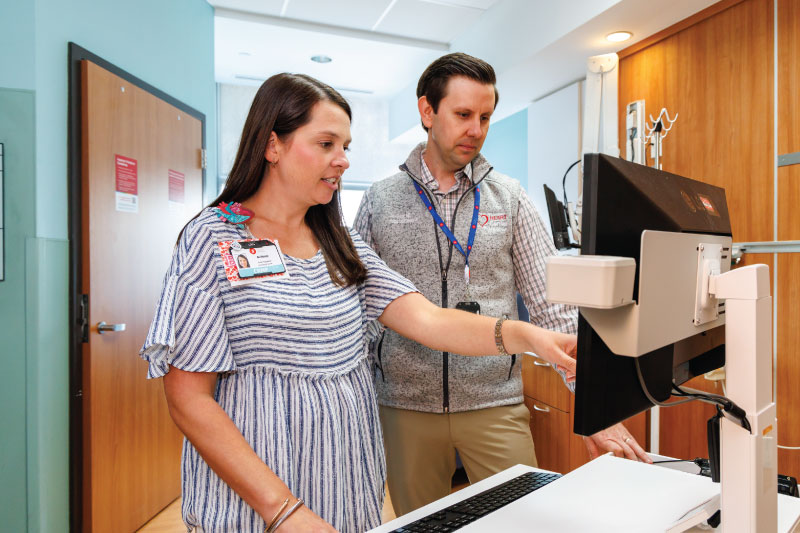
Brittany Abercrombie, NP, and Alan Brock, M.D., discuss the progress of a patient in the Hearts at Home program.

As the reputation of the Children’s of Alabama Pediatric and Congenital Heart Center of Alabama has grown, so has the success of its programs. Case in point—Hearts at Home, an interstage home monitoring program for any patient with single ventricle physiology who has undergone their first palliation procedure. In the last five years, the program has seen steady growth in the number of these patients, and leaders say the center’s reputation is among the reasons why.

“I think as a heart center in general, we’ve just had an influx of patients,” said Brittney Abercrombie, a nurse practitioner and the coordinator of Hearts at Home. “And so by default, that means that we are having more interstage patients.”

When Abercrombie moved into her role five years ago, Hearts at Home was caring for six to eight patients at a time. Now, she says they typically have about 13. Yearly, the program follows as many as 30, compared with 23-25 when she began. In the last couple of years, they’ve attracted more patients from outside Alabama, including children from Georgia, Tennessee and the Pensacola, Florida, area. Some of the program’s patients chose Children’s over other options in the region.

“I think they recognize that our outcomes here are some of the best in the Southeast,” said Alan Brock, M.D., the program’s medical coordinator. “And when they have the opportunity to look around and pick which program they want, I think patients are choosing us.”

As a result of the program’s success, hypoplastic left heart syndrome—a condition that brings many patients to the program—has become one of the most common forms of single ventricle congenital heart disease the hospital treats, Brock added. “I think it’s because we’re getting better at what we do and we’re saving a lot more lives now,” he said. “That is part of the reason that there are more patients coming into our program.”

What is Hearts at Home?

Through the Hearts at Home program, the families of patients with hypoplastic left heart syndrome and other forms of single ventricle congenital heart disease have access to education and technology that helps them to monitor and track their child’s heart health at home during the period between their first and second stages of palliation—procedures designed to repair their congenital heart defect. This time is tenuous for the child and often stressful for the parents, requiring a great deal of medical management, including monitoring, medications, adhering to strict feeding regimens, checking vital signs and having emergency access to equipment. “I think especially for these first-time parents, they don’t know what’s normal and what’s not,” Abercrombie said. “They’re not only learning to parent, but they’re learning how to parent a medically fragile child, so I think that’s a big challenge for them.”

There’s also the threat of morbidity, which is what led to the creation of interstage monitoring programs. The effort began in 2008 with the formation of the National Pediatric Cardiology Quality Improvement Collaborative (NPC-QIC). Since then, interstage monitoring programs across the country have succeeded tremendously, dropping the interstage mortality rate by more than 40%, Brock said.

The programs are effective because of their focus on education, data and communication. The work begins before a family even leaves the hospital. While there, they go through extensive training to help them understand their child’s condition, how to manage it and the warning signs that might arise. Once they’re home, they track all of their child’s vitals—specifically heart rate, oxygen and saturations—through an app called Locus Health. This data is accessible by the patient’s care team, giving them a look at the patient’s trends and helping them to quickly identify any problems. “It helps us see the whole picture while they’re at home,” Abercrombie said. If any issues do arise, the family can connect with the care team via messages through the app, and providers can even use the app for telehealth appointments, if necessary.

In one case at Children’s, monitoring may have saved a child’s life. Abercrombie says the team detected a change in heart rate and some feeding intolerance, which, combined with the patient’s trends, indicated they needed medical attention. The team called the mom, got the patient in for a visit and prevented a medication overdose. “If we didn’t have [the monitoring], there’s a good chance that could have ended up in a mortality,” Abercrombie said.

The team

The Hearts at Home team includes, in addition to Abercrombie and Brock, cardiologists who see most of the interstage patients, a nutritionist who specializes in cardiovascular disease, a social worker and speech therapists. Nurse practitioners or intensivists are available to answer parents’ questions 24 hours a day, which can be reassuring. “It is just a very small group of people that are caring for these patients day in and day out, along with the family,” Abercrombie said. “And so I think that they feel a lot of comfort and confidence in knowing that there’s someone there to talk with them and help them throughout the day.”

This frequent communication can lead to close relationships between the parents and the care team—so much that when the child eventually “graduates” from the program (after having their second palliation procedure) and no longer has the same level of access to the team, the achievement is often bittersweet.

“It’s a good thing,” Abercrombie explains to the parents. “It means your baby has a much more stable heart. You shouldn’t need us as much. They can do a lot more normal baby things.”

“But [the parents] do have a little bit of sadness about losing kind of that access,” she added.

When a new patient enters the program, the team contacts their pediatrician to share information about the patient’s condition and explain how the program works and what to expect. They also reach to local EMS in the patient’s community to inform them that a congenital heart disease patient lives nearby so they’ll be prepared in case there’s ever an emergency.

Going forward, the program may expand to older patients. Brock hopes to focus future efforts on neurodevelopmental outcomes and “how these kids develop throughout the course of their single ventricle life,” he said. Nationally, the NPC-QIC recently merged with the Fontan Outcomes Network to form Single Ventricle One (SV-ONE) in an effort to follow these patients beyond their palliation procedures into their teens and beyond.

Nephrology

Exploring the Link Between Childhood Adversity and Adult Heart Disease

Children’s of Alabama researchers are using an NIH grant to study the link between childhood adversity and adult heart disease.

Children’s of Alabama pediatric nephrologist Michael Seifert, M.D., and cardiorenal physiologist Jennifer Pollock, Ph.D., have received a five-year, National Institutes of Health-funded grant to explore the link between stressful childhood experiences and increased risk for cardiovascular disease in adulthood.

“We’re trying to study how exposure to early life stress (ELS) starts to have an effect in childhood on your cardiovascular system,” Seifert said. ELS includes adverse experiences such as physical and emotional abuse or neglect before age 18.

Studies over the last 20 years have linked ELS to adult-onset heart disease and other poor health outcomes like diabetes, mental illness, cancer and high-risk health behaviors. “But despite that, we still know relatively little about the mechanisms connecting the two,” Seifert said.

Seifert and Pollock will test their central hypothesis: ELS causes immune cell activation and inflammation, leading to vascular dysfunction and increasing the risk for hypertension and cardiovascular disease (CVD) later in life.

The investigators will follow a group of 300 adolescents from racially diverse backgrounds to identify critical clinical features and molecular pathways in ELS-associated CVD risk. Early research shows that this population has increased vascular stiffness and ambulatory diastolic blood pressure as well as pro-inflammatory metabolite and gene methylation patterns in plasma and circulating monocytes, respectively.

Seifert and Pollock will use comprehensive profiling to measure vascular stiffness and blood pressure and analyze the metabolome and epigenome—chemical signatures in blood and genes. The goal is to identify inflammatory and molecular pathways linked to cardiovascular changes. The grant also includes two basic science studies that will further inform the clinical trial and a similar study in young adults who had early-life stress exposure.

While it might seem counterintuitive to have nephrology specialists working on a cardiovascular health study, the two are closely linked. “We expect the same things increasing cardiovascular risk probably also increase chronic kidney disease risk,” Seifert said. “There is a lot of cross-talk between the cardiovascular system and the kidneys.” Findings may reveal new therapeutic targets. “This study has important translational potential,” Seifert said. “If we identify something in adolescence that’s driving this, maybe we can mitigate some effects of early-life stress.”