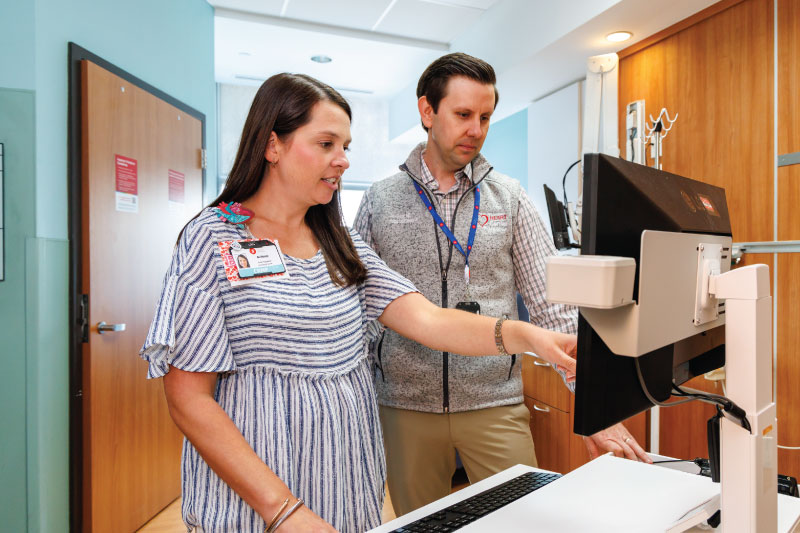

Jamin Sinclair-Lee, RN, (right) leads a rounds discussion outside of a patient room in the Children’s of Alabama Heart Center.
By Conan Gasque
In mid-2024, the Children’s of Alabama cardiovascular services team implemented a shift in the way they handled daily rounds. Instead of having attending doctors, fellows, or residents lead them, they decided to put nurses in charge. It was a quality improvement (QI) project that represented more than a process change; it handed the leadership role to the people closest to the patient. And its impact has been significant.
“It makes the most sense,” said Ashley Moellinger, MSN, CPNP-AC, MSHQS, the team’s lead pediatric nurse practitioner, “because [the nurse] knows the patient best, has been with the patient all along.”
Santiago Borasino, M.D., a cardiac intensivist at Children’s, agrees, saying it not only gives the nurse a greater voice, but puts the entire team in a better place. “It actually pushes the team to become a little bit more interdisciplinary where we all have something to say—we all have something to add to the plan.”
That’s crucial for the nurse and, by extension, the patient. For young nurses in particular, Borasino pointed out, it’s not always easy to speak up about the patient’s needs when a physician is leading rounds—even though the nurse may understand the needs better.


“Having them present allows them to have the microphone and to be able to say what they want to say,” Borasino said. “They can choose what they say instead of having to interrupt us or correct us or bring up what they think needs to be done when we didn’t say it.”
More than two years after Children’s started the project, which was led by Caitlin Arney, RN, it’s now a core philosophy in the Children’s of Alabama Pediatric and Congenital Heart Center. “It used to be that if the nurse wasn’t at the bedside for whatever reason, we would start without the nurse,” Borasino said. “Now we don’t. The nurse is always there because they’re integral to this concept.”
“I think that it’s been one of the best things that we’ve done on our unit, honestly,” Arney said. “Just because it’s gotten everybody together, everybody on the same page, and really allowed our nurses have more of a voice.”
The nurse’s presence helps standardize the process. “They use a script and a piece of paper, and it’s the same thing every time, whereas when someone else presents, it’s kind of what they think should be shared,” explained Moellinger, who serves as co-director of quality improvement in the Heart Center.
This standardization is one reason the QI project has made a significant impact on the effectiveness of rounds within the Heart Center. According to data gathered by the interdisciplinary nurse-led rounds task force that spearheaded the project, nurse-led rounds have sparked a statistically significant change in discussion of the patient’s history, titration goals for vasopressors, fluid balance goals, respiratory support weaning goals, withdrawal assessment tool scores, state behavioral scale scores, vital sign goals, and rescue medication plan. The group’s report also highlights improved communication among the interdisciplinary rounding team and a boost in confidence among the nurses, some of whom were initially skeptical of the new strategy.
“They went from being really sort of anti and not really wanting it to now they love it,” Borasino said.
They also feel more heard, Arney said, and that has affected the whole unit. “Our team is working better together than ever,” she added. “And truthfully, I feel like our patients are safer because rounds have become a place where everyone’s voice is heard.”
Moellinger and Borasino have twice presented data on nurse-led rounds at the annual Pediatric Cardiac Intensive Care Society (PCICS) conference.
The Impact of Nursing in the Heart Center
Nurse-led rounds is just one of many nurse-led QI projects the Children’s cardiovascular services team has implemented over the last few years. Below are some of the most recent ones. While they’re too new to have any significant data yet, they do provide hope for the possibility of improved processes and outcomes, especially in light of the success of past projects. “I would say nothing changes without the investment of those frontline people,” Moellinger said. “You have to have buy-in.”
The projects underscore the pivotal role that nurses play on the Heart Center team. “Nursing is extremely important for our center,” Borasino said. “And the relationships we have with our nurses are an extremely important part of the outcomes that we have and the work and joy that we all have.”
CURRENT NURSE-LED QI PROJECTS
Vital Signs and Parameters
Each patient has their own set of goals, limits, and parameters for their vital signs. In an ideal situation, the care team is discussing these numbers and entering them into the monitors at the patient’s bedside. The process ensures that the patient is staying within the proper range, and it can—through the use of alarms—help the team identify when the patient might be at risk for an adverse event, which would trigger the need for provider intervention. But if the correct numbers are not entered, the alarm may not go off when needed, or it may go off too frequently—creating a white-noise situation where a nurse might develop the habit of reflexively silencing the alarm every time.
To correct this issue, the team originally implemented a QI project in 2019, when alarms were sounding hundreds of times per bed each day, according to Borasino. That project helped to dramatically reduce that number. Now, in a second iteration of the project—led by RNs Abi Capouya, Emily Beach, and McKenna Leahy—the team is taking more steps to ensure that the alarms go off at the right time. Moellinger says the project focuses on ramping up daily discussions about each patient’s vital signs, while also auditing and adjusting processes to ensure that providers are being notified when limits are surpassed. With this latest version of the project, which started in mid-2026, the team hopes to reduce cardiac arrest rates and identify patient deterioration sooner.
Dual Sign-off Process for Medications
To decrease medication errors, the Heart Center team has used a process called independent double check, which simply means that when administering high-risk medications to a child, two people must independently check that the medication is being administered properly. With the recent installation of new smart pumps designed to help with double check, the process is changing. That’s why the team—led by RNs Haley Cobb, Samantha DeArman, and Yanci Horton—has implemented a QI project to ensure that each step of the new drug administration process, now called dual sign-off, is being taken. This can include following the medication bag to the pump, making sure it’s programmed correctly, checking that the medication is reaching the patient in the correct access port, along with other responsibilities. “We haven’t really had a good step-by-step process for what double check looks like, which has made the compliance low,” Moellinger explained. “And especially now that we have these new pumps, there’s going to be a different process because you electronically sign off or hand off the drug together with a signature in the [electronic medical record].”
“We’re really trying to focus on and hone in on that process itself to help with medication errors,” she added.
Emergency Simulation
When an emergency arises in the Heart Center, preparation is crucial. Everyone on the team needs to know how to respond. That’s why leaders recently implemented a QI project in collaboration with the Children’s Pediatric Simulation Center for training. “We’ve really started pushing into a lot of different areas and using simulation to help everybody get more comfortable with those emergent situations,” Moellinger said.
Missy Britton, CRNP, and Matt Clark, M.D., have led the effort alongside Sara Ewert, a nurse educator in the Simulation Center. One recent training simulated an emergency involving a patient on a ventricular assist device in a CT scanner, requiring multiple disciplines to respond.
In the Cardiac Care Unit (CCU), the team has also worked on response time to emergencies and the various responsibilities that come along with those, such as getting defibrillator pads on a patient, drawing up emergency drugs, administering drugs, recognition of deterioration, and administering bedside epinephrine.
“They’ve been doing a lot of one-on-one education, which is not really with the sim lab, but they’re simulating events in short segments to really work on all those responses,” Moellinger said.
Goals and Other Projects
With each of these nurse-led QI projects, the primary goals are improvement and sustainability. Eventually, leaders want the new processes to assimilate into the culture of the unit. Many previous projects have achieved that level of success, giving Moellinger and Borasino the hope that the newer projects will also become accepted standards.