
Browsing Tag

COVID-19

Neonatology

Pandemic Practices and Neonatal Health Issues

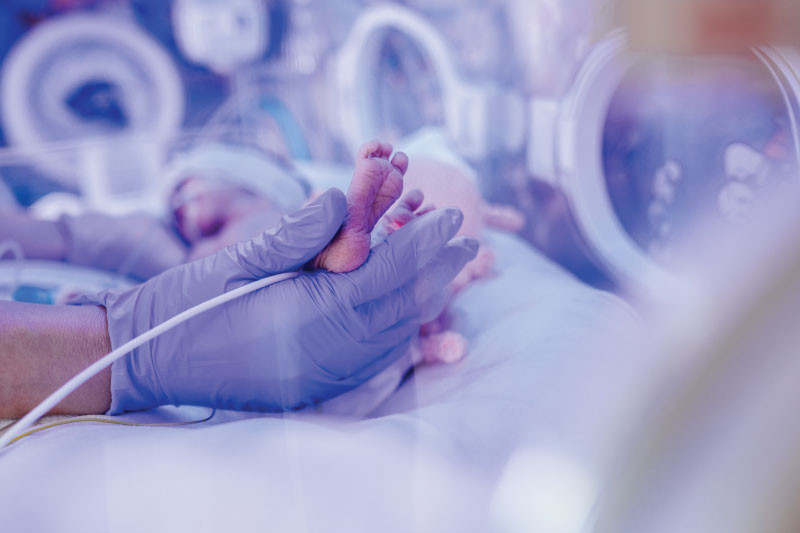
A study led by Children’s researchers shows the link between pandemic health behaviors and neonatal health issues.

By Hannah Echols, UAB

Studies show that social distancing and other public health measures during the COVID-19 pandemic effectively reduced the spread of the deadly virus. However, they had unanticipated effects such as reduced health care accessibility and utilization, especially in high-risk populations.

Researchers at Children’s of Alabama and the University of Alabama at Birmingham (UAB) evaluated potential effects of pandemic-related behavior changes on neonatal mortality and preterm birth rates. A correlation was found between the social distancing index, a measure of overall social distancing behaviors observed, and higher rates of neonatal and early neonatal mortality, as well as preterm birth, when assessed with a lag period. Results were published in July in JAMA Network Open.

“COVID-19 affected the health care systems globally, and many lives were lost; it is important to learn from this experience to prepare better for possible future health crises,” said Vivek Shukla, M.D., assistant professor in the UAB Division of Neonatology and lead author of the study. “We need to understand how changes in health behavior affected outcomes, whether people had limited access to care or healthy habits were altered.”

Maternal pregnancy complications increase the risk of preterm delivery and neonatal morbidity. These complications are a major contributor toward neonatal mortality. During the COVID-19 pandemic, pregnant women encountered substantial obstacles in accessing health care. 

According to the American Medical Association, 81 percent of physicians were providing fewer in-person visits when surveyed in July and August of 2020 than pre-pandemic and the average in-person visits fell from 95 to 57 per week.

“The observed correlations may be due to changes in health care access during periods of increased social distancing, such as fewer prenatal visits,” said Rachel Sinkey, M.D., associate professor in the UAB Division of Maternal-Fetal Medicine and co-author of the study. “These appointments are important to catch and address complications that could be life-threatening to both mom and baby.”

Defining the trend

The population-based study used data from the Centers for Disease Control and Prevention’s National Center for Health Statistics. The team evaluated neonatal mortality and preterm birth rates from 2016 to 2019 and compared them to 2020 rates. In unadjusted comparison, the rates appeared to be lower. When adjusted for a declining trend observed in the 2016-2019 period using an Auto Regressive Integrated Moving Average model, the rates were not significantly different.

Shukla further analyzed the correlation between the Social Distance Index—which indicated overall population mobility during the pandemic—and neonatal mortality and preterm birth rates in 2020. On a first look, there was no significant correlation; but when a lag period was added, higher SDI was associated with higher neonatal mortality rates with a two-month delay and with higher preterm birth rates with a one-month delay.

“With these in-depth analyses, we could account for the effect of a potential delay, or lag time, receiving access to care could have on the mortality and preterm birth rates,” Shukla said.

“The results indicate a need for more in-depth studies on the unintended effects of pandemic-related health behavior changes,” he added. “Conducting additional studies is an important step for providers and public health experts to better prepare in case there is a next public health crisis.”
Hematology and Oncology, Inside Pediatrics

Children’s Pediatric Oncologists Spearhead Registry of Children with Cancer, COVID 

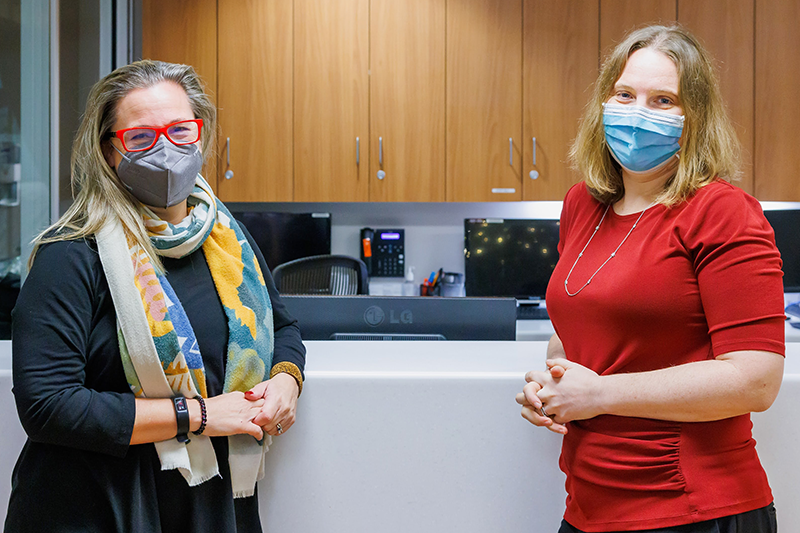
Left, Julie Wolfson, M.D., and right, Emily Johnston, M.D., are pediatric oncologists at Children’s of Alabama and assistant professors in the Division of Pediatric Hematology/Oncology in the University of Alabama at Birmingham Department of Pediatrics. Left, Julie Wolfson, M.D., and right, Emily Johnston, M.D., are pediatric oncologists at Children’s of Alabama and assistant professors in the Division of Pediatric Hematology/Oncology in the University of Alabama at Birmingham Department of Pediatrics.

Left, Julie Wolfson, M.D., and right, Emily Johnston, M.D., are pediatric oncologists at Children’s of Alabama and assistant professors in the Division of Pediatric Hematology/Oncology in the University of Alabama at Birmingham Department of Pediatrics.

What started as a conversation among a Facebook group of pediatric oncologists at the pandemic’s start has now grown into the largest registry of children with cancer and COVID-19 in the country, providing invaluable information for healthcare providers grappling with the effects of the virus on their patients. 

“People started posting in the Facebook group about caring for children with cancer and COVID-19, asking what they should do,” said Children’s of Alabama pediatric oncologist Emily Johnston, M.D., who, with her colleagues Julie Wolfson, M.D., and Jenn Levine, M.D., of Cornell Medical Center in New York, helped found the Pediatric COVID-19 Cancer Case (POCC) Report. “There were no data, no guidelines, nothing,” Dr. Johnston said. The registry, which is now housed at the University of Alabama at Birmingham, is led by Drs. Johnston and Wolfson.  

The growth has been “miraculous,” Dr. Johnston said. “We started these conversations in March 2020 and had our first patients entered by the end of April, representing an incredible pace.” Today, the registry has data on more than 1,400 children from more than 100 sites. “The other hospitals are participating in the registry because it’s the right thing to do for our community and our patients,” she said. “The national collaboration has been really impressive.” 

One goal of the registry is to provide real-time information to pediatric oncologists. The team sends regular data briefs to every pediatric cancer site in the country with updated summaries. 

In December 2021, the group published its findings on 917 children from 94 U.S. hospitals in the prestigious Journal of Clinical OncologyThey found these children had a high risk of severe infection, with one-third admitted to the hospital and 9 percent to the ICU. They also found nearly half (45 percent) had their cancer therapy changed because of the infection. Fourteen (1.5 percent) died from COVID-19.  

The children most likely to develop severe disease with COVID-19 infections were age 11 or older; those with health conditions in addition to their cancer; and those with neutropenia (low white blood cell count) or hematologic cancers. Hispanic children were most likely to be infected and to have their cancer therapy modified, even though they didn’t have more severe illness. This, Dr. Johnston said, mirrors the racial and ethnic disparities seen in the wider population with COVID-19.  

She and her colleagues are working on understanding why Hispanic children were more likely to have their treatment changed. “This may reflect a combination of systemic issues, biological issues, and even our innate biases. It’s probably a combination of all these, and definitely something we need to tease apart to figure out why this is happening.” 

Dr. Johnston and her team are now collecting data on the vaccination status of all patients, including those in the registry, and the impact of vaccination on infection. They also have a small grant to delve deeper into the data, including to assess how COVID-19 in children with cancer has changed over the course of the pandemic and determine the impact of the virus on long-term health. 

An important area they hope to research focuses on the impact of treatment changes. “We’ve had such incredible improvements in survival in the last several decades in part because we’ve gotten more treatments and escalated treatment, including giving more intense, frequent chemotherapy,” Dr. Johnston said. “That’s led to improved survival. We get very nervous when we have to hold or modify chemotherapy.” 

The two Drs. Johnston and Wolfson said they feel a calling for the work. “We felt it was our duty to use our research infrastructure for this public health purpose,” said Dr. Wolfson. “Hopefully, we’ll be able to help patients and clinicians as much as possible.” 

Inside Pediatrics, Nephrology

COVID-19 Infection May Leave Kids with Kidney Problems

Although children were far less likely to contract COVID-19 during the early days of the pandemic, they were affected. As of July 1, 2021, the American Academy of Pediatrics and the Children’s Hospital Association reported more than 4.04 million children had been diagnosed with COVID-19 in the United States; 50,439 in Alabama.1 Since the pandemic’s start, Children’s of Alabama has treated over 500 infants and children with COVID-19 and almost 100 with multisystem inflammatory syndrome (MIS-C), the long-term repercussions of which are just now emerging. 

Many affected children, like adults, have developed acute kidney injury (AKI) during hospitalization for severe disease, particularly children who have been hospitalized with MIS-C. One study of 152 children who had either acute COVID-19 or MIS-C found that AKI occurred in 10 percent of patients. These children had longer lengths of stay in the hospital and increased risk of other medical conditions.2 Another study of 52 patients with COVID-19 found that nearly 30 percent developed AKI.3 

“The jury is out on how much of that was due to severe illness versus how much the virus plays a direct role,” said Children’s nephrologist Erica C. Bjornstad, M.D. Some reports surmise that the virus is toxic to the kidney, but, Dr. Bjornstad said, more evidence is needed. Nonetheless, it appears that children who developed AKI while hospitalized need long-term follow-up as the long-term implications are not yet fully understood, she added. 

Thus, primary care physicians caring for these children after discharge should have a “high level of suspicion” if urine tests show high levels of protein, or children demonstrate new onset hypertension,” Dr. Bjornstad said. “They should look for COVID-19 as a culprit.” In fact, she suggests urine tests for all children who had COVID-19, even if they had a mild form of the disease, although no formal guidelines have been released. If the problem doesn’t resolve, the children should be referred to a nephrologist. “We don’t have a good handle if it goes away,” she said.  

“We’re still learning how this plays out since the pandemic is still not over,” Dr. Bjornstad said. Plus, “we don’t know what the fall holds with the Delta variant and as more people move indoors,” she added. 

Dr. Bjornstad and others at Children’s are involved with a large study that is mining an international registry of COVID-19 patients (children and adults) to tease out the effects on the kidney. Ideally, she would like to obtain funding to follow former patients for a prolonged period of time, “so we can keep learning and have data to support standard guidelines,” she said. 


1 Children and COVID-19: State-Level Data Report. American Academy of Pediatrics. July 1, 2021. Available at: https://services.aap.org/en/pages/2019-novel-coronavirus-covid-19-infections/children-and-covid-19-state-level-data-report/. Accessed July 7, 2021.

2 Basalely A, Gurusinghe S, Schneider J, et al. Acute kidney injury in pediatric patients hospitalized with acute COVID-19 and multisystem inflammatory syndrome in children associated with COVID-19. Clin Invest. 2021;100(1): 138-145

3 Knight, P.P., Deep, A. Save the kidneys in COVID-19. Pediatr Res (2020). https://doi.org/10.1038/s41390-020-01280-x