
The bridges that connect UAB and Children’s of Alabama play a key role in the Bridging the Fetus collaboration.
By Conan Gasque
Among the crucial features of Children’s of Alabama’s Benjamin Russell building, which was added to the hospital’s campus in 2012, is a set of bridges that connect Children’s to the University of Alabama at Birmingham (UAB) Hospital. The two institutions have worked in partnership for decades, and the building and adjoining bridges further enhanced the relationship. Specifically, they allowed for patients to be transported efficiently from one hospital to the other when necessary for care. A collaboration called Bridging the Fetus takes advantage of this arrangement to help patients with congenital heart disease. It’s helped save many lives, even in some of the most dire situations.
The collaboration involves the Children’s cardiovascular ICU team, cardiologists, cardiac surgeons, UAB’s Maternal-Fetal Medicine team, and neonatologists. And the bridge, of course, which is perhaps the program’s most unique feature.
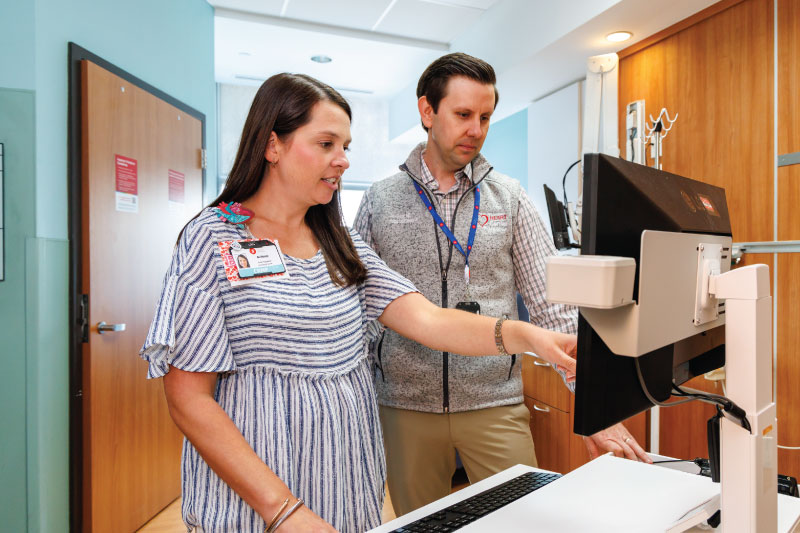
“The setup we have with the bridge is a big deal for us because it allows us to best take care of moms but also best take care of babies by being so close,” said Laura Brasseale, MSN, CRNP, chair of the Children’s cardiac fetal team.

Proper care for both the mom and baby is vital in these cases because many of the congenital heart diseases the team handles are identified prior to birth. Thus, the team must have a detailed plan in place for delivering the baby at UAB, then getting it to Children’s for care while the mom remains at UAB. Thanks to the bridge that connects the UAB Women and Infants Center to the Children’s Heart Center, the transfer can happen in mere minutes. As a result, Children’s and UAB have taken referrals from other parts of the Southeast in these cases where, in another city, the delivering hospital might be 20 minutes or farther away from the Children’s hospital. “It is very unique to our situation that we have all these resources literally connected to each other,” Brasseale said. Few other hospitals in the Southeast offer this type of setup.
The collaborative effort of Bridging the Fetus begins as soon as a patient is diagnosed with a congenital heart disease. Brasseale follows each case and takes information from the mom’s clinic visits with obstetricians and cardiologists. She uses this info to compile a list with data to help the team plan for the delivery. Before the baby is born, the team provides advice and counseling for the parents. They also arrange logistical services, such as transportation assistance, long-term stay options and other resources. Lactation specialists meet with the mom to discuss feeding options and the importance of breast feeding. Palliative care assists with end-of-life decisions, if necessary.
From the time the diagnosis is made, members of the team meet regularly to discuss details of the case and form a plan of care for the child’s delivery. “It just makes us aware so that we save beds for these neonates,” Brasseale said. “We get them transferred over from [the UAB Regional Neonatal Intensive Care Unit] as soon as possible so that we can plan their next steps after birth.”
Typically, the next steps involve taking the child across the bridge to be seen immediately by the heart team and undergo and operation shortly thereafter. The mother, meanwhile, remains at UAB to be cared for at the Women and Infants Center.
Cases like these are highly complex, Brasseale said. And the biggest challenge is the simple fact that no one knows when the baby will arrive. But Bridging the Fetus streamlines that for everyone. “We plan according to your due date, according to whether mom has any pre-existing conditions, whether she’s had other children before, where they live. All of that plays a factor in terms of how we plan for delivery on these babies.”
Because of the planning, the team will know if the baby needs immediate care or if they can stay in the NICU for a few hours until a bed opens up. “It’s definitely a good heads up and provides a multidisciplinary approach for the family,” Brasseale said, “because Maternal-Fetal Medicine can refer them to genetic counseling and the neonatologist so the family can meet a wide variety of people before having the baby. So it can kind of calm nerves as far as that goes.”
The team also prepares the family by giving them hospital tours beforehand so they’ll get “an up-close look of who is going to be taking care of their baby and what their baby’s future looks like,” Brasseale added.
The most notable success stories owed to Bridging the Fetus involve babies with hypoplastic left heart syndrome with intact atrial septum. Babies with this condition lack intracardiac shunting, so oxygenated blood can’t reach the body. Most require immediate extracorporeal membrane oxygenation (ECMO) cannulation after birth to increase the chance of survival to palliative surgery.
Children’s and UAB have seen four such cases since they started Bridging the Fetus in 2016. Three of the babies were cannulated onto ECMO within 15 minutes of birth. Two had successful heart transplants. The results far exceed those at other centers, Brasseale says, and it’s due to the team’s coordinating and multidisciplinary approach. Just getting everyone on the same page has a complexity of its own, with multiple service lines involved and each one featuring 10-20 people with rotating on-call schedules. “There are so many players. I think that’s the biggest part,” Brasseale said. “So it’s just nice for the information to all be in one place considering there’s so many different people who need to be involved.”
The team also is participating in research related to its work with Bridging the Fetus. One study is taking a look at how delayed cord clamping among neonates with congenital heart disease can effect neurodevelopmental outcomes. Another is a collaboration with the Pediatric Cardiac Critical Care Consortium (PC4) and aims to advance understanding of the maternal-fetal environment and its influence on postoperative outcomes in children with congenital heart disease. “The role of maternal characteristics in postnatal outcomes is a major knowledge gap in the treatment of congenital heart disease,” Brasseale said. “Identifying these prenatal risk factors is the first step toward developing therapeutics to modify them.”
The team hopes these studies will pave the way to a better understanding of these highly complex neonates, which can only help further streamline their care and produce more positive outcomes.
“It’s really cool to see the team come together to provide the best care for the patient, because it’s a lot of different people from a lot of different disciplines and even hospitals,” Brasseale said. “But it’s very exciting to see a baby thrive that was really not destined to have a good outcome. So it’s very exciting to be a part of such a big team.”