
Browsing Tag

NeuroNICU

Inside Pediatrics, Neonatology

Generous Donation to NeuroNICU B.R.A.I.N. Program Helps Reduce Risk of Brain Injury in Premature Infants

NICU_WEB

Through a generous donation by Robert and Kathleen Israel, Children’s of Alabama is now home to new technology that helps dramatically prevent brain injury and improve brain development and function in its sickest patients.

Children’s of Alabama is thrilled to announce a very generous gift of a cutting-edge technology designed to help reduce the risk of brain injury in preterm infants. The gift was donated by Robert and Kathleen Israel in honor of the care their daughter, Ivy, received in the Neonatal Intensive Care Unit (NICU) in 2018. Ivy is home and doing very well. “The NICU team at Children’s of Alabama saved our daughter’s life,” said Robert Israel, “and we are forever grateful.”

“This new technology made possible by the Israel family is helping us  dramatically prevent brain injury and improve brain development and function in our sickest patients,” said Manimaran Ramani, M.D., director of the NeuroNICU program.

Preterm infants born at 30 weeks or earlier are at higher risk for developing intraventricular hemorrhage (IVH), which is associated with long-term neurocognitive and motor deficits. The risk for neurocognitive and motor deficits is also higher for term infants with hypoxic-ischemic encephalopathy (HIE), seizures, metabolic disorders, or stroke, and those undergoing ECMO therapy.

However, a multidisciplinary initiative in the NICU at Children’s of Alabama and the University of Alabama at Birmingham (UAB) called NeuroNICU B.R.A.I.N. (Brain Rescue and Avoidance of Injury in Neonates) aims to prevent and reduce neurocognitive and motor deficits in high-risk neonates.  

The objective of the B.R.A.I.N. program is to identify and prevent brain injury early in high-risk neonates through state-of-the-art diagnostic techniques and neuroprotective care. An interdisciplinary team of medical professionals meets every week to strategize individualized comprehensive neuroprotective plans for infants enrolled in B.R.A.I.N.

Though standard vital monitoring techniques used in NICUs such as blood pressure, heart rate and pulse oximetry provide valuable information about the infant’s hemodynamic status, such standard monitoring techniques don’t provide real-time information regarding the brain’s oxygenation saturation, oxygenation extraction and perfusion status of a sick neonate.

This is where infrared spectroscopy (NIRS) monitoring comes in. “This technology allows us to monitor cerebral oxygenation in very sick infants,” Ramani said. It is a non-invasive method that can be used continually at the bedside as well as during surgery to monitor the health of the brain. It can also be combined with amplitude-integrated electroencephalography (aEEG) to monitor cerebral electrical activity and to diagnose seizures in sick neonates in real-time.

“With the two NIRS devices donated by the Israel family, we are now able to monitor the brain health and adjust our therapies and strategies in real-time on our patients,” Ramani said.



Neonatology

NeuroNICU B.R.A.I.N. Program Aims to Improve Outcomes in High-Risk Neonates

Neonatology_Care Protocols

Preterm infants born at 30 weeks or earlier are at higher risk for developing intraventricular hemorrhage (IVH), which is associated with long-term neurocognitive deficits. The risk is also higher for infants with hypoxic-ischemic encephalopathy (HIE), those undergoing ECMO therapy, or those with seizures, metabolic disorders or stroke. Now, a new initiative in the University of Alabama at Birmingham (UAB) Division of Neonatology called NeuroNICU B.R.A.I.N. (Brain Rescue and Avoidance of Injury in Neonates) aims to prevent or reduce that risk.

The core of the initiative is a multidisciplinary team of professionals who work to provide neurodevelopmental care for infants at risk for developing brain injury and cognitive deficits. The team includes a pediatric neurologist, pediatric rehabilitation medicine specialist, pediatric neuro-radiologist, neonatal nurse practitioners, nurse manager, physical therapist, occupational therapist, speech therapist, respiratory therapist and nurse champions. The program also makes parents an integral part of the team.

“We all come together every week and discuss every baby on the unit,” said Allison Black, M.D., NICU associate medical director at Children’s of Alabama. “Before the NeuroNICU program, we would consult individually on an as-needed basis.”

Even though an infant may not need every aspect of care, she said, “everyone working together to integrate the different expertise we have in our field will result in better care for the babies.” The program also uses a standardized bundle of care designed to stabilize the infant and carefully monitor for clinical signs that can increase the risk of IVH.

“The process for the brain injury prevention program starts at birth and continues throughout the entire hospital stay,” said Maran Ramani, M.D., who directs the NeuroNICU program. The protocols call for preventing hypothermia, hypoglycemia and extreme variations in the blood pressure and carbon dioxide levels, and for maintaining fluid intake, all with minimal stimulation. Once discharged, all infants are followed long-term and continually assessed for developmental milestones, he said.

In addition to multidisciplinary care, the program provides near infrared spectroscopy monitoring for preterm and term infants to assess the oxygen saturations in the brain. It also uses transcutaneous CO2 monitoring for preterm infants to assess variations in serum CO2 levels, which plays a critical role in the development of IVH. Term and preterm infants also receive a head ultrasound in to screen for IVH, while preterm infants with grade III and IV IVH undergo   conventional electroencephalogram to detect subclinical seizures. Finally, infants with HIE have an MRI with spectroscopy to assess any damage.

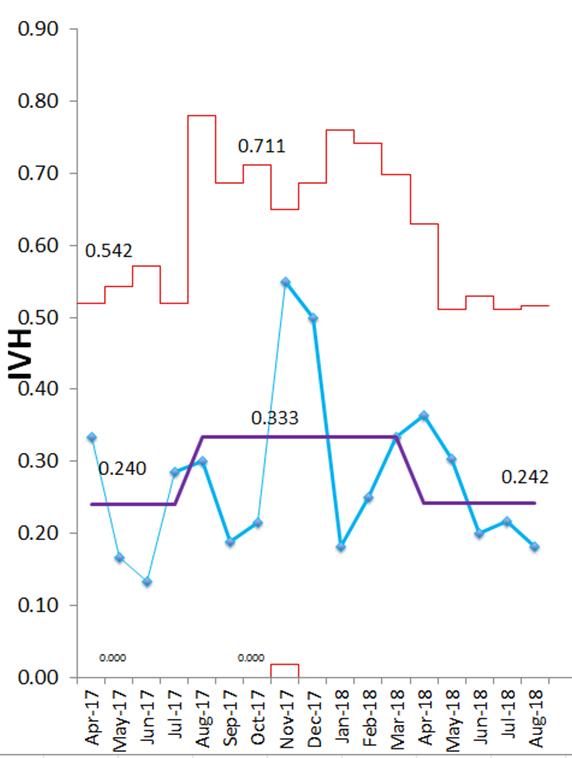
Despite the multifactorial etiology of IVH, Ramani said, standardizing the neuroprotective care is reducing the overall rate of IVH in preterm infants (Figure 1).

Figure 1           Rate of IVH Before and After NeuroNICU B.R.A.I.N. Program

Neonatology Care Protocols Chart

Arrow indicates NeuroNICU roll out

Managing Neurologic Disorders
Visit www.uab.edu/medicine/peds/patient-care/neuro-related-programs-centers to learn about the Division of Pediatric Neurology’s subspecialty clinics at the University of Alabama at Birmingham.