
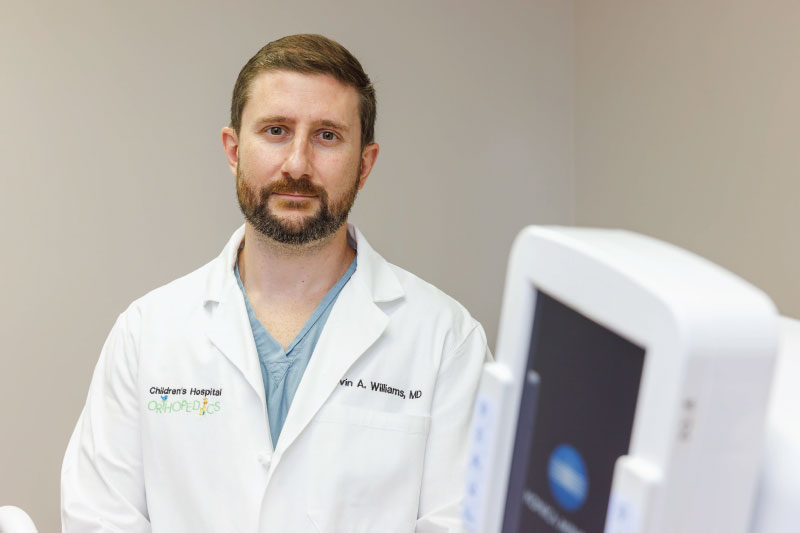
Kevin Williams, M.D., is spearheading an initiative designed to improve musculoskeletal infection treatment at Children’s.
Characterizing musculoskeletal infections in children can be far trickier than in adults, especially in children under 5, posing challenges for pediatric orthopedic surgeons to decide on the best course of treatment.
This dilemma has spurred an innovative collaboration between the orthopedics and radiology departments at Children’s of Alabama to determine which young patients might be best-suited for special MRI imaging techniques that can both be performed quickly—avoiding sedation—and represent the best hope for distinguishing crucial infection characteristics.
Between 500 and 1,000 children are evaluated at Children’s each year for musculoskeletal (MSK) infections, which occur spontaneously at higher rates than in adults and can lead to complications such as osteomyelitis.
“Many children under 5 can’t tell you where it hurts specifically or if they have symptoms like muscle aches or chills, and we have to get a lot of information from their parents,” explained Children’s orthopedic surgeon Kevin Williams, M.D., who is spearheading the orthopedics-radiology initiative.
While X-ray and ultrasound imaging can help, MRI represents the gold standard for determining many infection characteristics. “Ultimately, it tells us if a child needs an operation to treat their infection or if it could get better with antibiotics and supportive care,” added Williams, who’s also an assistant professor of orthopedic surgery at University of Alabama at Birmingham (UAB). “That said, getting an MRI can be tricky, especially in the age group of those kids who can’t participate well in a clinical exam. And if they’re in pain, they can’t necessarily hold still for an MRI.”
Williams and his colleagues have been tracking improvements over the past decade in technology and MRI techniques that can counteract this problem. Research just last year, he says, assessed “specific MRI sequences or sets of images that can be performed expediently to avoid sedating or putting a child to sleep for the MRI, and they’re also good enough quality for clinical decision making.”
Children’s of Alabama’s orthopedics and radiology departments are now working together to determine which of the hospital’s MRI machines are capable of this technology. They’re also consulting with anesthesiologists to determine which young patients may be suitable for those types of MRIs.
In the fall of 2024, the teams were able to develop a “FAST protocol” for musculoskeletal imaging to assist with efficient clinical decision making. This protocol takes typically less than 15 minutes and does not necessitate sedation or gadolinium contrast application. It has significantly improved treatment protocols for these infections, and the team anticipates it will reduce health care expenditures, time in the hospital, and most importantly, it will be beneficial to patient outcomes.
“We are constantly striving to revolutionize the care we give to the children of Alabama with musculoskeletal infections,” Williams said. “Innovating our practice with the help of the most recent medical literature will keep us at the forefront of delivering the best patient care possible.”

No Comments