
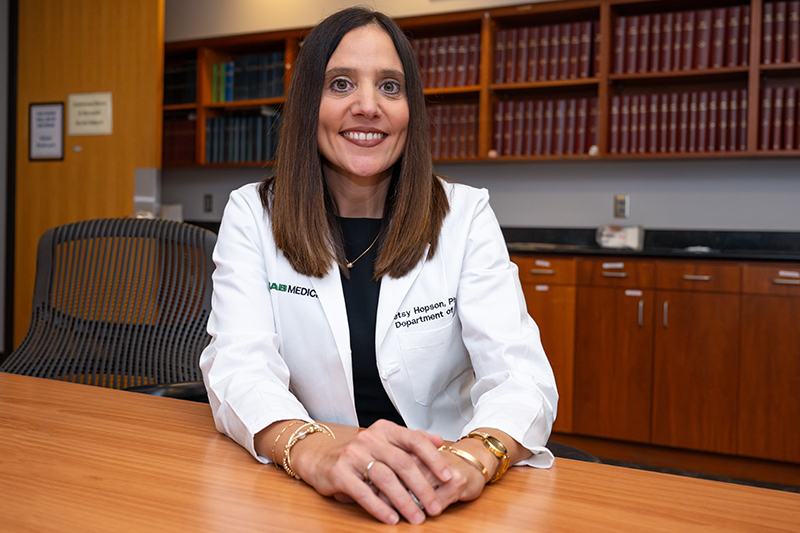
Betsy Hopson, Ph.D., MSHA, recently moved into a new role within the Division of Pediatric Urology.
Betsy Hopson, Ph.D., MSHA, describes her philosophy in one word: listen.
“Early in my career, I adopted this principle that if I heard the same story from two or more patients then it was either a research question or a quality improvement opportunity,” she said.
That mindset has shaped nearly two decades of work at Children’s of Alabama and the University of Alabama at Birmingham (UAB) and now underpins her new role as an assistant professor and health scientist in the Division of Pediatric Urology. There, she will direct a clinic dedicated to helping children with congenital urologic conditions transition to the adult health care setting.
Hopson began her career at Children’s in 2006 as coordinator of the Spina Bifida Program in the Division of Pediatric Neurosurgery. Yet she spent nearly as much time interacting with urology, she said, which plays a central role in bladder management for patients with the disease.
Her early work focused on helping patients make the difficult transition from pediatric to adult care. After realizing that young adults with spina bifida were aging out of pediatric clinics without clear adult pathways, she returned to school to earn a master’s degree in health care administration and then built an internationally recognized transition model.
It was listening to her patients, however, that led to the next chapter in her life.
In one case, a 15-year-old adolescent asked her about her research. When she told him it was sexual and reproductive health, “He whispered, ‘Betsy, I can’t do that, can I?”’
“Can’t do what, buddy?” she asked. “Date or have sex,” he answered. “That’s not for me, is it?”
Or the newly engaged, college-educated young woman with spina bifida who burst into tears when Hopson started discussing birth control with her. “You mean I can get pregnant?” she said. “I had no idea.”
“If this young woman who is very educated had no idea,” Hopson said, “what is this like for the rest of the population?”
And a light bulb went off. “We’re telling them we want them to be independent, that we want them to take care of themselves, but we’re not giving them any carrot or showing them what’s possible and helping them paint that picture of what adult life could look like.”
Her “eureka” moment led her back to school to obtain her Ph.D. in Rehabilitation Science and a certificate in Mixed Methods Research. Her goal was to understand gaps in sexual health education for people with congenital diseases like spina bifida. What she uncovered was far more troubling.
“Because these patients are prescribed catheterization for bladder management early in life,” she said, “they’re taught the technical skills of catheterization but not taught about personal boundaries and appropriate touches.”
Her research found that 46% of adults with spina bifida reported a history of sexual abuse. For her dissertation, she validated a clinical screening tool to identify abuse risk and gaps in sexual health knowledge.
In her new role with the urology team, she sees her goal as twofold: “One is to help support normal development,” she said. “I want to normalize sexual and reproductive health conversations so patients can see what’s possible and give them space to imagine a full adult life.”
The other involves educating patients, parents and clinicians about the increased risks vulnerable patients face and developing tools for clinicians and families to identify and talk openly about those risks.
It’s important, she noted, to bring the parents into the discussion. “When you bring [sexuality] up in the clinical setting in front of their child, they might be initially hesitant.” Her solution is the same approach that has guided her career: listen first. That means holding focus groups with patients and parents to shape new curricula and ensure the content reflects lived experience rather than clinician assumptions.
“If there’s one thing my career has taught me,” she said, “it’s to never stop learning and never stop looking for ways to make a difference.”

No Comments