
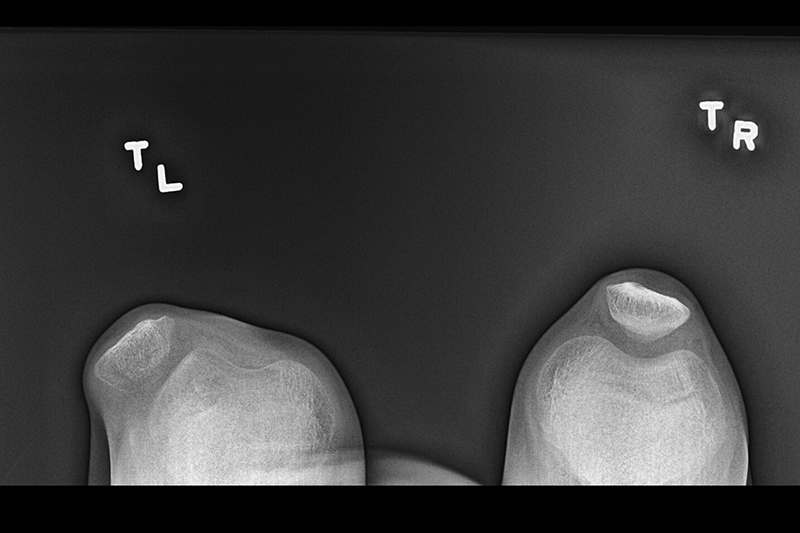
An X-ray showing a displaced left kneecap
For Kevin Williams, M.D., and the Children’s of Alabama orthopedic team, patellar instability is a commonly seen problem. The condition—in which the kneecap repeatedly slips out of place—and all of its inherent challenges have been the subject of much discussion worldwide recently, Williams says. But he and his team have developed a solution—a modified procedure that combines existing, well-established methods and is already showing promise.
The procedure is called medial patellofemoral ligament (MPFL) reconstruction. Williams and his team began developing a modified version of it about two years ago and refined it in 2025. They’ve used it on approximately 15-25 patients, and the results have been encouraging. “Children and adolescents that are still growing and developing have been able to get back to doing activities they enjoy—like dancing and gymnastics—faster compared with our previous, more invasive procedures,” he said. “Complications have been scarce so far in the early stages of this modified procedure.”
The Challenges of Patellar Instability
The procedure treats a problem that is challenging for several reasons, perhaps most notably the various ways patellar instability can present. In some cases, a child might have been born with a kneecap problem or developed it early in childhood, which means the body is used to the anomaly. When treating children, orthopedic surgeons also have to manage challenges such as small bones and growth plates, “which we don’t want to impede or create any problems with, because it could be detrimental toward a kid’s growth,” Williams explained.
Williams and his team developed the modified procedure to address all of these challenges. It allows them to use small implants that are stitch-based or suture-based and don’t require a lot of drilling. It also allows surgeons to spare the growth plate and balance the soft tissues.
How it Works
MPFL reconstruction in young adolescents is performed in a limited fashion by surgeons in North America and abroad, Williams says. To perform the procedure, the surgery team creates holes in the bones to attach the kneecap to the inside of the femur bone via either an allograft or autograft tissue source. This surgery uses smaller instrumentation and grafts for this procedure to spare the growth plate and account for the smaller anatomy. “The surgical procedure is designed to grow with the patient,” Williams said.
Though the procedure is different from others that are available, it’s not experimental, Williams says, because it’s a combination of techniques that are already standard practice. The implants used in this procedure are approved by the U.S. Food and Drug Administration.
Recovery
One of the biggest benefits of the new technique is recovery time. “Compared with the bigger anatomy-changing surgeries, it’s much improved,” Williams said. With modified MPFL reconstruction, the patient is typically on crutches for only a week or two before they’re able to walk around mostly normally. After that, they wear a brace for up to two months. In many cases, they’re back to playing sports within three or four months, although some may need six months depending on factors such as age and underlying conditions.
Risks Compared to Alternatives
Another benefit is decreased risk. Though every surgery comes with risks, Williams says the modified MPFL procedure seems to carry fewer risks compared to conventional techniques, especially when it comes to issues with the growth plate.
Wide Range of Uses
Part of what makes the procedure successful is its ability to treat patients whose kneecap issues stem from a variety of causes. For example, many children with Ehlers-Danlos syndrome, Down syndrome, Klinefelter syndrome and other congenital conditions are often predisposed to having kneecap problems. Williams and his team have successfully treated them with the modified MPFL procedure. It also works for patients with Nail-Patella syndrome and Genitopatellar syndrome. The Children’s orthopedic team sees many of these types of cases because they serve the entire state of Alabama.
Looking Forward
Despite the success of the procedure, it’s not something the team pushes. Williams says they typically try conservative approaches first, such as braces—which don’t typically work well in these cases—or rehab. But he says it’s a good option if surgery is needed.
Williams anticipates that they’ll learn more as they perform more of these procedures. With the hospital’s move to a new electronic health record system, the team is working on strategies for better tracking outcomes. “That’s one of the goals for this year—we’re planning on tracking patient-reported outcomes more effectively and becoming more involved in national registries to track procedural success and contribute to research more vastly in the U.S. and abroad,” he said.
So far, the team and their patients have been pleased with the impact of the modified MPFL procedure. “We’ve been happy with the breadth of underlying conditions our modified procedure treats, with decreased complications, and with increasing capacity for returning to sport,” Williams said.

No Comments