
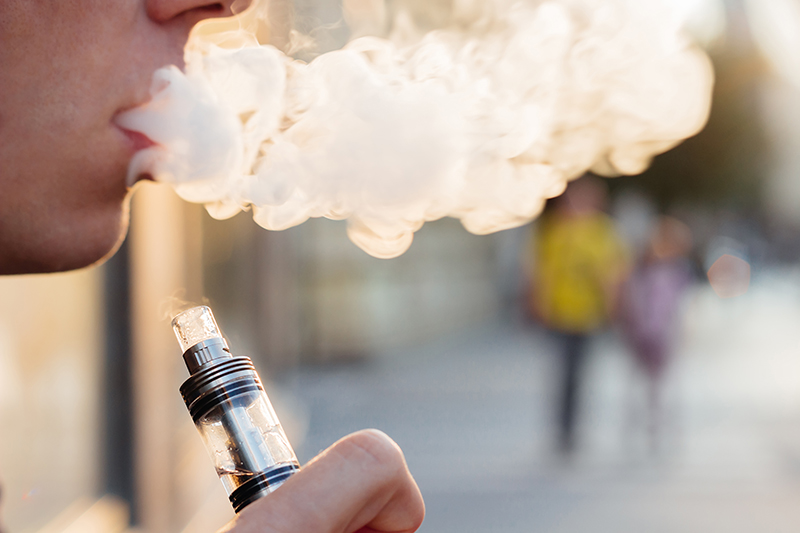
More than 5% of all middle- and high-school students say they use vaping devices. (Stock photo)
By Maureen Salamon
When Children’s of Alabama pediatric pulmonologists Isabel Lowell, M.D., and Brett Turner, M.D., speak to kids or their parents about vaping—which remains prevalent in middle- and high-school students despite a simultaneous decline in cigarette smoking—they continually find themselves battling the misconception that vaping is somehow safer.
Social media and advertisements for vapes, which are marketed in hundreds of teen-tempting flavors, have convinced kids that vaping isn’t the major health threat it is. But Lowell and Turner vigorously dispel such myths as part of a Youth Tobacco Prevention Program run in partnership with the Children’s of Alabama Tobacco-Free Task Force.

According to the U.S. Food and Drug Administration’s National Youth Tobacco Survey, about 5.2% of all middle- and high-school students say they use vaping devices, and 27.5% of those say they use these products every day.
“We’re uniquely positioned to take this on, since it’s an issue that affects both patients and families,” said Turner, who’s also the medical director of Children’s Respiratory Care Services and an associate professor of pulmonology at the University of Alabama at Birmingham (UAB).
“This has been a very important part of how we provide education about vaping not only to kids in the community, but the Department of Pediatrics and the Division of Pulmonary Medicine,” added Lowell, who’s the medical director of Children’s Pediatric Pulmonary Care Unit and a professor of pulmonology and sleep medicine at UAB.
Lowell and Turner took over the program two years ago. Funded by a grant from the Alabama Department of Public Health, it involves several goals, including:
- Teaching about the dangers of vaping to at least 1,000 students in grades 5 through 12 in Birmingham and the surrounding areas.
- Providing anti-tobacco and vaping information at four or more community events.
- Working with students at local middle schools and high schools to train them on vaping and facilitate their ability to lead peer-to-peer presentations.
- Conducting 10 community adult presentations on the dangers of smoking and vaping.
- Creating social media content on vaping to post on Alabama Department of Public Health social media sites.
- Providing material and resources on vaping to school nurses and counselors, as well as answering questions.
- Conducting assessments of vape and cigarette advertising at local gas stations and other retailers who sell vapes.

Independently of the grant, Lowell and the Pulmonary Asthma Team are surveying adolescents at Children’s severe asthma clinics on the use of vapes and cigarettes, as well as secondhand exposure. While anyone who vapes is exposed to many toxic chemicals that can damage and inflame airways and compromise the immune and cardiovascular systems, “in kids, there are harmful effects on the brain, affecting learning, impulse control, and mood,” Lowell said. “Vaping can also be especially dangerous for children with underlying lung disease.”
“We often see adolescent patients struggling to compete at the same level sports-wise as they had, feeling like they can’t take a deep breath,” Turner explained. “As we dig deeper into their social habits, we discover they’re vaping and that the timing of their respiratory symptoms aligned with when they developed chronic vape use.”
During their school presentations, Lowell and Turner also dispel the popular misconception that using nicotine boosts mood. In contrast, it “becomes something that drives more worry and fear and mood swings,” Turner said.
Students seem very open to the program’s message, Lowell and Turner say, and they plan to continue the program as long as funding remains. “We also provide them with resources to quit,” Lowell added. “If they’re vaping, they know there’s help out there, and people and programs they can go to that will help them without punishment.”

No Comments