Browsing Category

Orthopedics

Orthopedics

How Dogs Are Transforming Pediatric Orthopedic Procedures

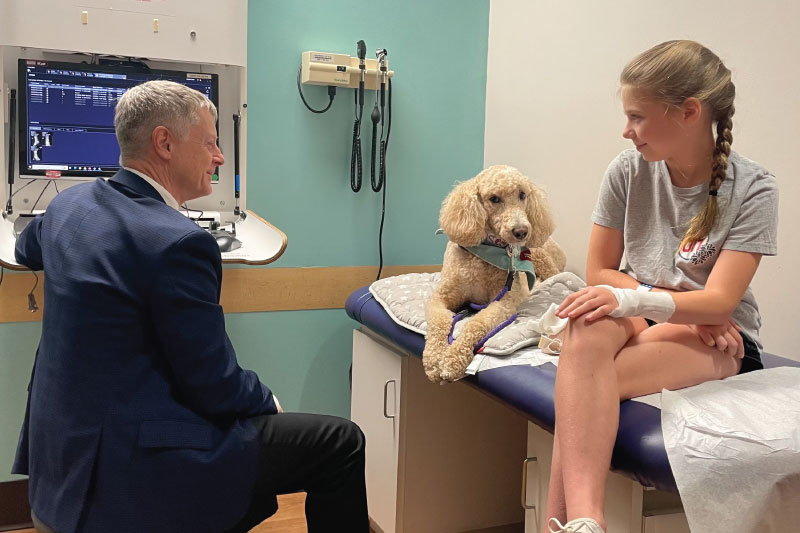
Dr. Michael Conklin and Shelby with a patient. (Photo courtesy of Judith Thomason)

What goes in must come out—including the metal pins used to hold bones together while fractures heal. “It probably takes 15 seconds to remove three pins,” Children’s of Alabama pediatric orthopedist Michael Conklin, M.D., said. “But, of course, kids are very scared about that.”

Enter Shelby. The 50-pound standard poodle is trained to sit on the examining table and cuddle with children while Conklin grasps the pins with a tool resembling a needle-nosed plier and pulls them out.

Basically, Shelby serves as a distraction, he says. “We tell the child to pet the dog and look toward the dog and not look at me on the other side of them, not worry about what I’m doing.”

Shelby remains calm no matter what, even with a screaming child. “She just sits there calmly and doesn’t do all the dog things that you and I know and love about our dogs,” Conklin said. “She’s trained to just be there for comfort.”

And it works. Well, for about two-thirds of patients. The rest “freak out no matter what,” Conklin said, but even then, Shelby has an effect. “It seems as if they return back to their baseline calm quicker after the procedure.”

Shelby also helps parents. “There’s a lot of value in the parents seeing that we’re trying to do our best for their child,” Conklin said. “Even though they know their child’s having to go through a procedure . . . it keeps us in good stead with them.”

Shelby’s brother, Foster, works with his sister at the Children’s South location as part of the Pups Unleashing Patient Smiles (PUPS) program, which is one of three branches of Children’s of Alabama’s animal-assisted program, PetsRX. Another branch involves longtime Children’s partner, Hand-in-Paw, which provides therapy dogs at Children’s of Alabama’s main hospital to provide comfort and distraction. The third is a hospital-based medical dog program which includes golden retrievers Wanda and Sydney to assist with scary or painful procedures. Meanwhile, suspected victims of child abuse—who are served by the Children’s Hospital Intervention and Prevention Services Center (CHIPS)—are assisted by dogs from the Help Empower Restore Overcome (HERO) Program with the Alabama Office of Prosecution Services.

The dogs aren’t just a cute addition. There is good science behind their use in the pediatric setting, with studies finding that animal-assisted therapy (AAT) can help children recover more quickly after surgery by improving mood and alertness, reducing perceived pain, and contributing to lower heart rates and blood pressure readings.[1],[2],[3] 

Animal-assisted therapy is also safe for the dogs, with studies showing no signs of stress or fatigue in therapy dogs when the programs are properly managed.[4] At Children’s, the dogs are overseen by a staff handler and rotated to ensure their well-being.

Soon, Shelby and Foster may be part of the scientific literature. Conklin and his team are conducting a randomized trial to evaluate the dogs’ effectiveness, comparing outcomes between patients who receive the therapy dog intervention and those who receive standard care. They are monitoring the child’s heart rate before, during and after the procedure to track how quickly they return to baseline and using a standardized anxiety scale that assesses facial expression, leg movement, activity, crying and consolability.

The goal is to, hopefully, show positive data that will pave the way for broader adoption of such programs.


[1] Calcaterra, V, Veggiotti, P, Palestrini, C, et al. Post-Operative Benefits of Animal-Assisted Therapy in Pediatric Surgery: A Randomised Study. PLoS ONE. 2015; 10.

[2] Braun C, Stangler T, Narveson J, Pettingell S. Animal-assisted therapy as a pain relief intervention for children. Complement Ther Clin Pract. 2009;15(2):105-109.

[3] López-Fernández, E., Palacios-Cuesta, A., Rodríguez-Martínez, A. et al. Implementation feasibility of animal-assisted therapy in a pediatric intensive care unit: effectiveness on reduction of pain, fear, and anxiety. Eur J Pediatr 183, 843–851 (2024). https://doi.org/10.1007/s00431-023-05284-7

[4] Palestrini C, Calcaterra V, Cannas S, et al.  Stress level evaluation in a dog during animal‐assisted therapy in pediatric surgery. Journal of Veterinary Behavior: Clinical Applications and Research. 2017; 17. https://doi.org/10.1016/j.jveb.2016.09.003.

Orthopedics

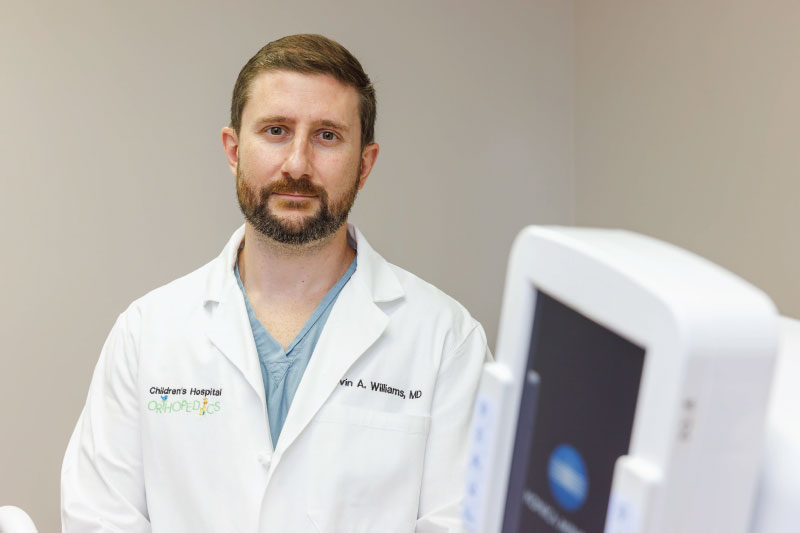
Williams leading new MSK infection collaborative

Kevin Williams, M.D., is spearheading an initiative designed to improve musculoskeletal infection treatment at Children’s.

Characterizing musculoskeletal infections in children can be far trickier than in adults, especially in children under 5, posing challenges for pediatric orthopedic surgeons to decide on the best course of treatment.

This dilemma has spurred an innovative collaboration between the orthopedics and radiology departments at Children’s of Alabama to determine which young patients might be best-suited for special MRI imaging techniques that can both be performed quickly—avoiding sedation—and represent the best hope for distinguishing crucial infection characteristics.

Between 500 and 1,000 children are evaluated at Children’s each year for musculoskeletal (MSK) infections, which occur spontaneously at higher rates than in adults and can lead to complications such as osteomyelitis.

“Many children under 5 can’t tell you where it hurts specifically or if they have symptoms like muscle aches or chills, and we have to get a lot of information from their parents,” explained Children’s orthopedic surgeon Kevin Williams, M.D., who is spearheading the orthopedics-radiology initiative.

While X-ray and ultrasound imaging can help, MRI represents the gold standard for determining many infection characteristics. “Ultimately, it tells us if a child needs an operation to treat their infection or if it could get better with antibiotics and supportive care,” added Williams, who’s also an assistant professor of orthopedic surgery at University of Alabama at Birmingham (UAB). “That said, getting an MRI can be tricky, especially in the age group of those kids who can’t participate well in a clinical exam. And if they’re in pain, they can’t necessarily hold still for an MRI.”

Williams and his colleagues have been tracking improvements over the past decade in technology and MRI techniques that can counteract this problem. Research just last year, he says, assessed “specific MRI sequences or sets of images that can be performed expediently to avoid sedating or putting a child to sleep for the MRI, and they’re also good enough quality for clinical decision making.”

Children’s of Alabama’s orthopedics and radiology departments are now working together to determine which of the hospital’s MRI machines are capable of this technology. They’re also consulting with anesthesiologists to determine which young patients may be suitable for those types of MRIs.

In the fall of 2024, the teams were able to develop a “FAST protocol” for musculoskeletal imaging to assist with efficient clinical decision making. This protocol takes typically less than 15 minutes and does not necessitate sedation or gadolinium contrast application. It has significantly improved treatment protocols for these infections, and the team anticipates it will reduce health care expenditures, time in the hospital, and most importantly, it will be beneficial to patient outcomes.

“We are constantly striving to revolutionize the care we give to the children of Alabama with musculoskeletal infections,” Williams said. “Innovating our practice with the help of the most recent medical literature will keep us at the forefront of delivering the best patient care possible.”

Orthopedics

Leading the way in limb deformity care

The Children’s of Alabama Limb Deformities Program is setting the standard in Alabama and beyond. (Stock photo)

Born with one leg shorter than the other, the young boy set two exciting goals after Children’s of Alabama chief of orthopedics Shawn Gilbert, M.D., corrected his condition with leg-lengthening surgery. The first was to buy a pair of “cool” sneakers that didn’t require lifts to align his gait; the second was to learn to ride a bike, which he couldn’t manage before.

Two decades later, Gilbert still keeps updates the boy’s parents sent him through the years, grateful for how their son’s life was transformed. It’s just one example of the thousands of young patients who have benefited from Children’s Limb Deformities Program, which launched after Gilbert’s arrival in 2003 and is now recognized for its deep expertise across Alabama and the globe.

“I often tell patients that limb-lengthening surgery is my favorite kind of surgery to do, because I still can’t believe it works,” said Gilbert, who’s also a professor of surgery in the Division of Orthopedic Surgery at University of Alabama at Birmingham (UAB). “Essentially what you’re doing is dividing a bone and stretching it apart, then watching it fill in with new bone in the gap. The whole process, to me, is really amazing and never gets old.”

Gilbert’s fascination with the field has helped cultivate a similar mindset among the department, which includes seven orthopedic surgeons—more than the total number of pediatric orthopedic surgeons in the rest of Alabama. Serving patients with conditions that include bone diseases and dysplasias like rickets and achondroplasia, Blount’s (a disorder in the growth plates in the bones around the knee), and undeveloped limbs, the program offers both surgical and non-surgical treatments for these children, whose mobility and morale can both suffer because of their differences.

About 140 young patients are enrolled in Children’s Limb Deficiency Clinic, which joins specialists from orthopedics and rehabilitation medicine to serve patients with amputations and other limb deformities.

“Some children have milder angular deformities (such as knock knees or bowed legs) that might not create a big functional deficit, but might be pretty noticeable,” Gilbert said. “Many parents report their children are teased or bullied on account of that. If their issue is bigger, they may need assistive devices, prostheses, or even be unable to walk and need a wheelchair.”

Surgical correction is the approach for 30-50 patients at Children’s each year, most of whom have limb deformities. Many patients are referred from other institutions across the state because of Children’s of Alabama’s reputation.

Gilbert, who has held leadership positions in state and national orthopedic organizations, recently spoke in China at a global conference focused on trauma repair, limb deformity correction, limb lengthening and limb reconstruction. “That’s one of the ways we’re recognized for our expertise in this area,” he said.

Now performing more pediatric limb reconstructions than anyone else in the Alabama, Children’s orthopedic surgeons would next like to examine how patient outcomes might be harmed by inequities in access to care. Since limb deformity treatments—especially lengthening procedures—involve a great many medical visits over a longer period of time, “there’s a big burden of care on the families, and having the resources to help with that is really important,” Gilbert said.

Orthopedics

Orthopedics team expands to meet increased demand

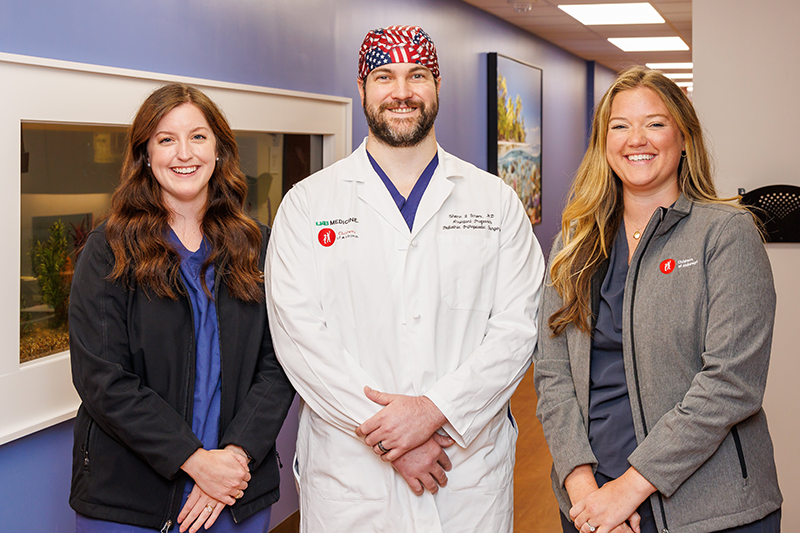
From left: Anna Stephens, MSN, CRNP; Shane Strom, M.D.; and Mallory Myers, PA

As the only stand-alone children’s hospital in the state and the sole tertiary referral center, Children’s of Alabama already fielded a robust demand for orthopedic services. But steady population growth in the Birmingham area—combined with lengthening waits for clinic appointments—have prompted Children’s to expand its orthopedic team to accommodate the need.

Since late 2022, the team has added two orthopedic surgeons and two advanced practice providers. The division now has six surgeons and four advanced practice providers. These empower the department to meet patients’ needs as demand increases. That has continued at a clip of 10% to 20% year over year since 2020, says orthopedic surgeon Kevin Williams, M.D., who came to Children’s four years ago.

“We’re constantly looking to provide better care for children of Alabama,” said Williams, who’s also an assistant professor of orthopedic surgery at University of Alabama at Birmingham (UAB). “One way was to put more providers in place who can take care of these patients in clinic and think about how to best care for children with difficult pathologies.”

Several thousand young patients seek inpatient and outpatient orthopedic care at Children’s each year. The most common conditions the team treats include fractures around the elbow—which comprise up to 70% of orthopedic surgeries at Children’s—along with scoliosis, hip dysplasia, cerebral palsy and other spastic neuromuscular conditions.

“There’s just an overflow of patients, so provider schedules were extremely full, and they were booking appointments months and months out,” explained pediatric nurse practitioner Anna Stephens, MSN, CRNP, who joined the department in 2023 after working in several capacities at Children’s since 2017. “More providers were needed to get patients seen in an appropriate time frame.”

The new faculty and staff members not only round out the department roster, but also add flexibility to everyone’s roles, said orthopedic surgeon Shane Strom, M.D., who joined in September 2023 after completing a fellowship in at Scottish Rite for Children in Dallas.

Advanced practice providers can see patients independently, freeing up surgeons for surgical cases. They can also assist in the operating room, Williams notes, “which, with the increase in OR numbers, has been really helpful.”

But, “not everything we do is surgical,” said Strom, who’s also an assistant professor of pediatric orthopedics at UAB. “With clinic numbers being higher and wait times to get in to see a provider longer, adding advanced practice providers can help with non-operative care, such as casting or treating club feet with bracing.”

Physician assistant Mallory Myers, PA, who joined the department in February 2023, agrees. “The expansion allows surgeons to have more time focusing on complex patients and surgical patients without making non-surgical patients wait longer times to be seen,” she said. “Also, nurse practitioners and physician assistants have a similar clinical scope, but the way we’re trained is different, so it’s a benefit to have multiple points of view.” 

Orthopedics

Improving practices for elbow fracture treatment

Children’s of Alabama orthopedic surgeons hope to streamline the process and reduce costs of elbow fracture treatment.

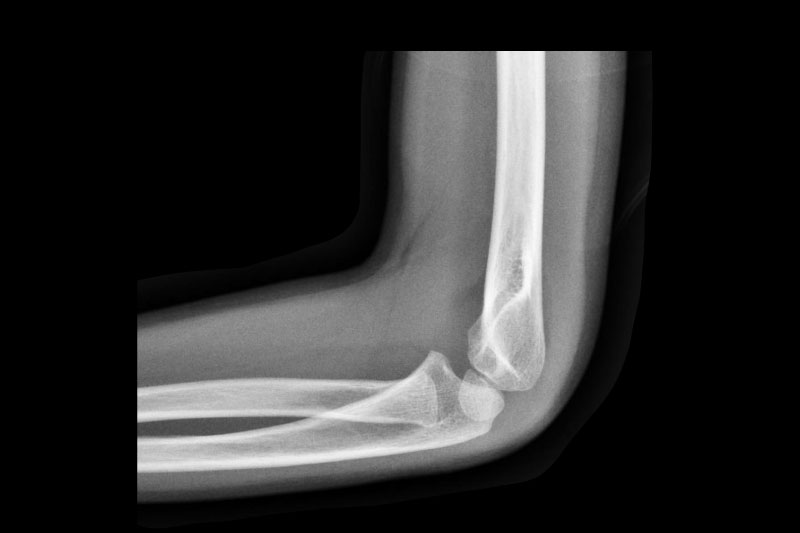
Elbow fractures are among the most common childhood injuries, accounting for about 10% of all childhood fractures. But according to a study led by Children’s of Alabama orthopedic surgeon Kevin Williams, M.D., the process for treating them isn’t as efficient or cost-effective as it can be.

Recently, Williams and his team evaluated a year’s worth—170 total—of supracondylar humerus fractures, a type of displaced break that occurs just above the elbow joint at the end of the humerus bone and needs to be put back in place and sometimes stabilized, often operatively. They found that surgeons at Children’s treated one of these fractures operatively every other day, but only 30–40% of patients were first seen at Children’s. The rest were transported from other areas of the state, with some coming from as far as Mississippi and Georgia. This means more time had elapsed before surgery, which is potentially problematic because prolonged displacement can increase swelling or compress nerves and blood vessels. This, in turn, increases the risk of compartment syndrome, a painful and debilitating condition that occurs when pressure within the muscles builds to dangerous levels, decreasing blood flow to nerve and muscle cells.

On average, transfers among cases in the study required almost three hours and came from about 70 miles away.

The study also assessed transportation methods, finding that children arrived faster when transported in private vehicles than ambulances. Patients often arrived unprepared for the immediate surgery required, and often, additional X-ray views were required to determine treatment.

Given the findings, Williams and his team are now investigating ways to streamline the transfer process and ensure patients arrive from other institutions ready for surgery.

They are also examining standard practices for non-displaced breaks, which can generally be managed with immobilization and usually don’t require surgery. Such patients often undergo repeated X-rays, which cost about $700 and expose the child to radiation. Williams’ findings indicate that obtaining repeated X-rays for such stable cases is unnecessary and too costly considering that the results don’t change the treatment modality.

Williams hopes to collaborate with other institutions to identify and develop best practices for managing elbow fractures. “Collaborative research allows updating approaches to continually provide the best, most up-to-date care for every child,” he said.

In the meantime, he advises prompt specialist referral for elbow fractures with rapid swelling, noticeable deformities, and impaired mobility. “It’s important to make sure that these children are seen as quickly as possible so we can give the care necessary,” he said.

Elbow fractures typically occur during play or sports when the child reaches out with their hands to block their fall. Proper and timely treatment is crucial to avoid long-term disabilities and complications.

“It’s very important for us to treat patients with displaced elbows operatively if the fracture is fairly displaced or angulated to make sure that the elbow heals and functions properly in the future,” Williams said.

“In this location, the bone doesn’t grow as much as other bones, such as those near the shoulder or wrist,” Williams said. “So, it’s imperative that we have these bones put back into place exactly where they were, or they could grow aberrantly with some type of angulation, causing some dysfunction in the future and potentially even resulting in nerve or muscle damage.”

Orthopedics

New XR Technology Improving Patient Care

New XR technology is enabling Children’s of Alabama orthopedic specialists to evaluate injuries more effectively.

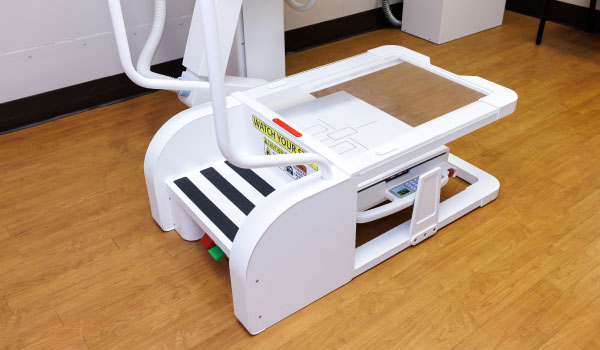
Children’s of Alabama has new XR technology in its sports medicine clinic, and orthopedic specialist Kevin Williams, M.D., says it’s a game-changer, enabling specialists to quickly determine the best treatments to get young patients back to their chosen game.

About 5,000 children and adolescents visit the clinic each year—some as repeat patients—seeking help for injuries and congenital bone malformations that include strains and sprains, fractures, torn ligaments and more. Until recently, decades-old X-ray equipment challenged clinicians’ ability to assess and treat these common musculoskeletal problems.

The new XR equipment, which is useful in about 75% of pediatric cases, includes an easily positioned moveable arm with a 135-degree range. The equipment has larger plates that can capture wider images of patients’ bones and soft tissue while “taking into account features of the joints above and below, allowing more comprehensive images while using less radiation,” Williams said.

“There’s also a dynamic mode that allows us to take live, fluoroscopic images or continuous X-ray to evaluate a bone or joint dynamically,” he explained. “This is crucial when we’re trying to inject a joint or aspirate it to get fluid out. The whole system is smaller and more modern, which improves ease of use dramatically.”

Children with ankle injuries have perhaps benefited most from the XR equipment so far, Williams said. “Sometimes, to avoid the need for CT or MRI images, we can use X-ray to determine which ligaments are loose and potentially need to be repaired or reconstructed around the ankle,” he said.

The system’s longer plates also help Williams and his colleagues evaluate leg alignment in patients who seek care for rotational injuries, congenital knock knees or bowed legs. This assessment can dictate if a patient needs bracing, physical therapy or even surgery in which bones may need to be broken and put back into place to align them better for the future and to prevent degenerative problems.

“The XR equipment has been incredibly helpful in terms of allowing us to make appropriate treatment decisions, and it’s much easier to use,” he said. “It speeds up our ability to get patients into the clinic and get an X-ray that’s more valuable to us while decreasing clinic wait times. It really affects almost every patient who comes in needing an X-ray, so it makes us more effective in treating pediatric sports patients.”