Browsing Tag

neurology

Inside Pediatrics, Neurology & Neurosurgery

Addressing Post-Traumatic Syndrome Disease from Hydrocephalus

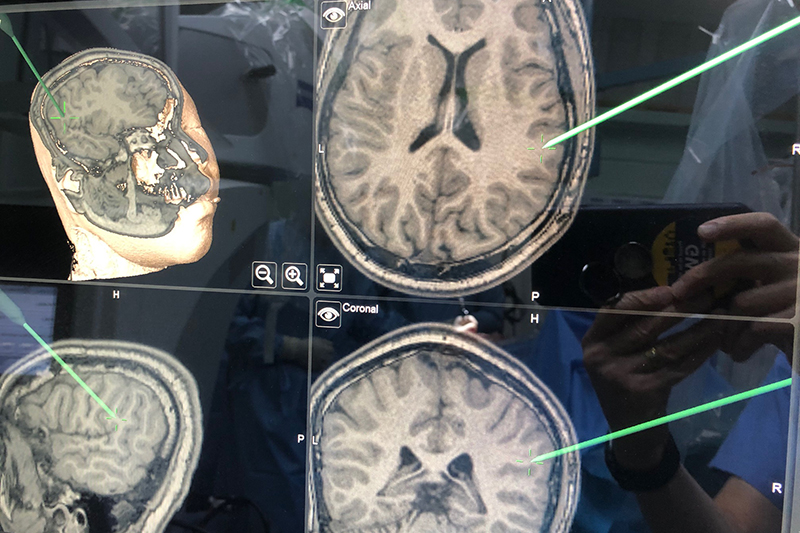
Hydrocephalus-Doctor-Brain-Scans-Resized-V2

Children’s of Alabama neurosurgeon Brandon Rocque, M.D.

It’s not surprising that kids with brain tumors and their parents experience a significant amount of stress and psychological distress during the acute post-diagnosis period. It even has a name: pediatric medical traumatic stress. As Children’s of Alabama neurosurgeon Brandon Rocque, M.D., studied this phenomenon a few years ago, it occurred to him that it would almost certainly apply to children with hydrocephalus. 

“We know that just encountering doctors or the medical system can be traumatic for children,” said Dr. Rocque. “For children, just coming to the hospital can be traumatic enough to trigger post-traumatic stress disorder,” or PTSD. 

Numerous factors contribute to stress, particularly the perceived threat to the child’s life. “Even if there isn’t a threat, the child perceives it as such,” Dr. Rocque said. Add to that separation from their parents, uncertainty about the outcome, and the unpredictability of a serious medical condition. “That describes hydrocephalus extremely well,” he said, because these children are treated with shunts that could become blocked at any time requiring additional medical interventions.  

Symptoms of shunt failure can vary widely. Some children simply have a mild headache; other patients can become extremely sick and be in danger of death within a couple of hours. By age 10, “the average child [with hydrocephalus] has had at least two shunt replacements. This is always hanging over the families,” Dr. Rocque said, putting them and their children at high risk for PTSD. 

To test his hypothesis, Dr. Rocque introduced a screening survey into the hydrocephalus clinic to screen for PTSD as well as anxiety, depression, fatigue and resilience. “We found that, overall, the kids with hydrocephalus are doing pretty well. But the parents are not doing so well,” he said. About one in five parents met the diagnostic criteria for PTSD based on their symptoms. More than half attributed it to their child’s condition.  

So why aren’t the kids as affected? One reason, Dr. Rocque said, is that the children don’t know anything different. They’ve lived their entire lives with the condition and the shunts. “But for parents, there was always something new and the risk that something bad is going to happen to their child,” he said.  

Not all the kids surveyed were fine, however. “Some had issues with PTSD, and those were the ones coming to the hospital more. Those whose shunts weren’t behaving well,” Dr. Rocque said. “We need to be aware that these kids have a higher risk for PTSD.”  

They also found that the children and their patients tested exhibited very little resilience, which can help protect against PTSD.  

A survey conducted in conjunction with the Hydrocephalus Association confirmed their findings.  

Dr. Rocque and his team are now working with the association to develop a program to help reduce the risk of PTSD in patients and their families and with a psychologist who is also the mother of an adult with hydrocephalus to develop a tool to help build resilience in patients and their families.  

“This is the first time anyone has really focused on the psychological comorbidities of this condition,” Dr. Rocque said. “I think it has the potential to have a big effect in our population.” 

Inside Pediatrics, Neurology & Neurosurgery

Exploring the Brain from the Inside Out

Pediatric neurointerventional radiology is a small but growing specialty, one increasingly in use given the growing number of endovascular procedures performed in children with neurovascular conditions. “It’s a niche specialty,” says Jesse Jones, M.D., Children’s of Alabama Chief of Neurointervention. “A lot of doctors don’t know about it—let alone patients.”  

Dr. Jones is part of the hospital’s vascular anomalies team, one of the largest pediatric vascular anomalies programs in the Southeast and the only one in Alabama. He works with an interdisciplinary team of experts specializing in the diagnosis, treatment and ongoing care of all vascular anomalies and is part of the team’s monthly clinic. 

On the adult side, neurointerventional radiologists spend a lot of time removing blood clots from stroke patients. But stroke is rarer in children. The hospital’s neurosurgeons and neurologists more often call on Dr. Jones to evaluate congenital anomalies, including vein of Galen malformation or arteriovenous malformations (AVM), as well as inflammatory disorders like vasculitis or obliterative vasculopathy. “It’s when a child presents with dangerous or unusual neurovascular findings and the team is trying to characterize it and plan future treatment that I come in,” he said. 

Dr. Jones, who completed a residency and two fellowships, uses minimally invasive techniques to diagnose and treat numerous neurovascular conditions, including stroke and AVM, but also aneurysms, and lympho-vascular proliferations of the head and neckThe beauty of his approach is that it helps avoid open incisions, reducing the risk of complications and enabling kids to go home sooner. 

His interest in pediatric medicine started with his grandfather, who was a pediatrician. “I looked up to the work he did treating children,” Dr. Jones said. “Working with adults can get frustrating because many conditions they have could have been avoided with lifestyle changes. But in children, they bear no responsibility.” 

Dr. Jones also knew he wanted to do something with the brain. “I’m fascinated with how the brain works,” he said. “It’s a miraculous organ and even after all these years of study still a bit of an enigma.” Being involved in a neuroscience-related field and interacting with other specialists who study the brain is intellectually stimulating, he said. “It’s the best of both worlds: I get to use my hands as an interventional radiologist and work with the brain too.” 

And, of course, work with children. 

Inside Pediatrics, Neurology & Neurosurgery

Children’s of Alabama Clinicians Bring Expertise and Training to Vietnam

Global Surgery NEW_WEB

Children’s of Alabama physicians review a brain scan at a hospital in Vietnam. Neurosurgeons, neurologists and other medical staff travel to Vietnam at least once a year to provide lectures and hands-on training at hospitals in Hanoi and Ho Chi Minh City as part of Children’s of Alabama’s Global Surgery Program.

Surgical interventions to reduce the burden of drug-resistant epilepsy in children have become an integral part of the field in the past 20 years. In low- or middle-income countries like Vietnam, however, it typically remains a vision, not a reality. Vietnam, for instance, has just two adult and two pediatric neurosurgery training programs for a country of 95 million people, and just four pediatric neurosurgeons serving a population of more than 50 million in the northern part of the country.

Enter Children’s of Alabama’s Global Surgery Program, which is designed to form strong, collaborative relationships with large pediatric hospitals in low- and middle-income countries and provide subspecialty fellowship training at Children’s. The hospital’s relationship with Vietnam began in 2013, with an initial visit to neurosurgeons in Ho Chi Minh City. Since then, a team from Children’s, including pediatric neurosurgeon Brandon Rocque, M.D., MS, FAANS, Pediatric Epilepsy Surgery Director Pongkiat Kankirawatana, M.D., Clinical Neurophysiology and Pediatric Epilepsy Program Director Monisha Goyal, M.D., and Director of Neuromonitoring Trei King, R.EEG.T, C.N.I.M., among others, has traveled the nearly 9,000 miles to Vietnam at least once a year to provide lectures and hands-on training at hospitals in Hanoi and Ho Chi Minh City. Their efforts have helped create premier epilepsy programs that draw children from throughout southeast Asia.

“We started with the corpus callosotomy,” Rocque said, a procedure performed on children with generalized epilepsy prone to drop attacks. It involves splitting the main connection pathway between the two cerebral hemispheres to prevent the attacks. The Vietnamese team, led by a neurosurgeon who specialized in brain tumors, performed two such surgeries with the Children’s of Alabama neurosurgeons, then went on to complete 10 themselves over the next six months, all with good long-term results.

Epilepsy surgery is not possible without advanced EEG monitoring, which is where King came in. His job was to teach EEG technologists how to use an EEG in the operating room, including electrode placements, and the most appropriate test for the child’s condition. “We started with the basics and now we’re going much deeper,” he said.

“The people there are extremely hard working and very, very smart,” King said. “They just didn’t have the opportunity and education. The training with our staff allows them to see the entire gamut of what we do in the field and, hopefully, grow to do what we do.”

The Children’s of Alabama team usually spends a week in each city, giving lectures and assisting with the more complex surgeries. “We’re not trying to hammer out a bunch of cases,” Rocque stressed. “The model is not missionary surgery; it’s teaching and working on the patients they asked us to assist with in order to reach a goal of improving specific techniques for the neurologists and surgeons.”

In addition to building the team’s skills in epilepsy surgery, the team hopes to improve how pediatric neurosurgeons are trained in Vietnam, Rocque said. Currently, residents are trained in neurosurgery but don’t receive any formal pediatric training. “There is a really big opportunity to improve the way pediatric neurosurgery is taught in this region,” Rocque said. To help in that goal, Vietnamese physicians and EEG nurses now come to Alabama for several months for focused training on various procedures.

The partnership has continued to grow, with the Vietnamese doctors sending PowerPoint presentations on difficult cases for discussion at Children’s of Alabama’s weekly multidisciplinary meeting, during which the neurology team develops treatment plans. Now the team also discusses the Vietnamese patients. “When we started, we often had to ask for more information and make some changes to the treatment plan,” Rocque said. “But over the last year, their own recommendations have been spot on.”

The experience has been eye opening for the Children’s of Alabama clinicians. “I found a pediatric neurology and neurosurgery program making a valiant effort in diagnosing and treating one child after another with minimal resources,” said Goyal, who visited City Children’s Hospital in Ho Chi Minh City. The children slept on cots that spilled out into the adjacent roofed but open courtyards and hallways, she said. “There were no fans and in September temperatures in Ho Chi Minh were far from balmy.” She was also struck by the fact that the government does not allow the use of benzodiazepines, one of the most common medications used to control seizures in the U.S.

However, Goyal said, “the small number of clinicians do an admirable job with limited resources. They learn from textbooks, not from mentors, even though they have much fewer technical and pharmacological resources.”

“As a physician, this has been a very rewarding experience,” Goyal said. She, Rocque and King are planning another trip this spring to Ho Chi Minh City to continue helping the hospital develop of its own pediatric surgical epilepsy program.

King echoed Goyal’s comments. “It’s been one of the most rewarding things I’ve experienced in my career,” he said. “You see the big difference you make not only in the training, but in the impact on the patients receiving care that they would not get unless we’re there.”

“The patients and families are so appreciative,” King said. “I’ve never experienced that level of appreciation before. I think a lot of it has to do with realizing that without the partnership and collaboration we wouldn’t be able to do the surgeries.”

For instance, he recalls one family whose child was operated on returning to the hospital a year later with a picture of the child to express their thanks. “Those are the things they make this so rewarding,” he said. “When we see the difference it makes in the life of the patients and families and the joy that continues long after the surgery.”