Browsing Tag

Neonates

Neonatology, Nephrology

New hope for neonates with severe congenital kidney disease

ECMO in use at Children’s of Alabama (file photo)

Almost a decade ago, Nephrology specialists at Children’s of Alabama embarked on a journey to improve outcomes in neonates with severe congenital kidney disease by adapting the Aquadex machine, a small extracorporeal circuit used for adults with heart failure. Traditionally, extracorporeal membrane oxygenation (ECMO) was deemed unsuitable for this population due to perceived nonviability. In 2016, at the family’s request, a baby with severe congenital kidney failure and severe respiratory failure was placed on ECMO to be given a chance at life. The baby also required kidney support therapy (KST) to survive. After receiving a kidney transplant at age 2, the child now goes to school, plays sports, sings and dances. 

Since 2016, of the 31 neonates with congenital kidney failure who were admitted to the Children’s neonatal intensive care unit (NICU), five required ECMO support and KST in the first two weeks of life. In February 2024, Kara Short, MSN, CRNP, CPNP-PC, David Askenazi, M.D., MSPH, and others published a case report in Pediatrics, highlighting the complex treatment of the five babies and the journey to NICU discharge for the four survivors. This study challenges the previous norms and conventions that these babies had no chance at life. 

Kara Short, MSN

Congenital kidney failure poses unique challenges to neonates, affecting not only renal homeostasis but also respiratory integrity. Diagnoses among the five patients in the study included posterior urethral valves, bilateral renal dysplasia and autosomal recessive polycystic kidney disease. Despite gestational age ranging from 35.6 to 37.1 weeks and birth weight from 2,740 grams to 3,140 grams, all five patients received KST by postnatal day seven. Additionally, they were all placed on ECMO within the first nine postnatal days due to severe respiratory distress after being unresponsive to conventional interventions.

Four of the five patients survived and are thriving today. Pulmonary hypertension resolved in each survivor, with three requiring no oxygen support and one needing only nocturnal oxygen. Three survivors underwent successful kidney transplants, while one awaits transplant evaluation. This challenges the traditional notion of reflexively assigning nonviability to neonates with congenital kidney failure and severe pulmonary complications.

This research highlights the significance of ECMO and kidney support therapy in mitigating the adverse effects of pulmonary edema, uremia and electrolyte complications. The use of a filter through the ECMO circuit—to perform continuous venovenous hemodialysis (CVVHD), continuous venovenous hemofiltration (CVVH) with the Aquadex machine, peritoneal dialysis and intermittent hemodialysis—showcases the synergism and need for different approaches to manage these complex cases.

David Askenazi, M.D.

Managing congenital kidney failure requires a multidisciplinary approach involving neonatology, nephrology, surgery and multiple ancillary divisions. “As healthcare providers, we all bring something to the table,” Askenazi said. “The families need clear, concise information so they can understand their options when making treatment decisions. Our job is to develop programs, systems and plans to help those kids have the best chance at life.”

The families of the neonates faced challenging decisions, including the choice of full medical support or palliative care. Despite the complexity and potential extended NICU stay, all five families opted for full medical support. Clear communication, counseling and informed decision-making were instrumental when families made medical decisions about their baby’s care.

The successful outcomes of neonates with congenital kidney failure undergoing ECMO challenge previous assumptions of nonviability. Meticulous ECMO, respiratory, nutritional and kidney support therapies are essential to favorable long-term results. Further investigation is needed to define the optimal strategies to improve outcomes in severe congenital kidney disease cases. “We want to share this information with other programs to let them know that these kids have a chance at life; what we learned in this very small cohort is that these lungs can develop and grow if given a chance,” Short said.

“When thinking about the future, we’re asking ourselves: How can we get the very best technology to care for these babies? How can we help other programs improve so they can better care for their kids? How do we ensure that families are counseled with all viable options in an honest and comprehensive way?” Askenazi said. “We will continue to make progress. We have recently received a grant from the National Institutes of Health (NIH) to partner with industry to make a better device for neonates. We recognize that we must continue to educate our colleagues across the U.S. and the world about what we have learned from these miracle babies.”

Inside Pediatrics, Neonatology

Debriefing after Resuscitation: A Quality Improvement Initiative

Resuscitation_WEB

In October 2018, the Children’s of Alabama Neonatal Intensive Care Unit embarked on a quality improvement project, Debriefing Following Resuscitation/Code Events in the NICU, to identify opportunities to improve the resuscitation process, including staff satisfaction. It is one of several quality initiatives led by the Children’s Hospitals Neonatal Consortium.

The Neonatal Intensive Care Unit (NICU) can be an intimidating and stressful place to work.  One of the most stressful events in the NICU is a neonatal code or resuscitation, which may require intubation, chest compressions and special medications, all delivered under the pressure of knowing that seconds count. This requires that the team of doctors, nurses, respiratory therapists, pharmacists and other practitioners work together like a well-oiled machine.

Resuscitation codes are, by definition, rare events, said Children’s of Alabama neonatologist Hannah Hightower, M.D. Weeks may go by without any and then they might have several in one month. But they are definitely disruptive and stressful.

In October 2018, the Children’s of Alabama NICU embarked on a quality improvement project, Debriefing Following Resuscitation/Code Events in the NICU, to identify opportunities to improve the resuscitation process, including staff satisfaction. It is one of several quality initiatives led by the Children’s Hospitals Neonatal Consortium (CHNC), a group of more than 30 children’s hospitals around the country dedicated to using performance improvement methods to improve the delivery and quality of care in Level IV NICUs, which care for high acuity and medically complicated neonates.

The premise is simple. As soon as possible after the code, everyone gathers for a few minutes to discuss what went well, any equipment or medication problems, communication quality, and, of course, highlighting what could go better next time. They also complete a short form documenting the discussion. In just three months, the team at Children’s exceeded its goal of holding post-resuscitation debriefings after 80 percent of codes.

Such approaches can lead to improved resuscitation quality and reduced mortality, research finds. [1]

“The goal is to help everyone involved in the process improve skills, cope with the stress, and ultimately and most importantly, improve the process and patient outcomes by identifying potential latent safety threats,” Hightower said. “We want everyone on the team to feel free to express any concerns as well as provide support. Even the caregivers need a chance to decompress.”  “Not only does it provide a venue for raising issues related to caring for the patient, she said, “but it also lets us show appreciation for the things that went well.”

“It wasn’t a surprise to hear that one of the biggest issues is communication in a stressful period,” Hightower said. “We can always improve communication, whether that means discussing who is leading the code or controlling the volume so everyone can hear and understand what’s going on.” Discussing communication issues shortly after the code is important, she said, “because it’s at the front of your mind. By doing this immediately, you remember things you may not later and can articulate issues that might not be apparent in a week or two.”

Since implementing the initiative, the team has begun a proposal to further improve communication by emphasizing who is leading the code. Future projects include providing each member a way to give real time feedback not just to the code event, but also to the quality and effectiveness of the debrief. “We want to quickly identify systemic matters that can be improved for the next event. This is to develop a culture of freely expressing ideas and working through issues together as a team,” Hightower said.

The team is still collecting data on the primary outcome of latent safety events, a key component of any quality improvement initiative. Secondary outcomes include quality of the debriefs and composition of the responding code team.

“I credit our success to our strong nursing leadership and the willingness of the staff to be actively involved in quality improvement and do the extra work required to accomplish that goal,” Hightower said. “They have to step away from the patient and cover for each other during the debrief and even though it may take just a few minutes, to ask a nurse to step away from the patient is a big task.”

Although the team is still collecting data on the impact on staff satisfaction, she said, “anecdotally we have heard from nurses and other staff who feel they had a chance to say what they needed during the code or might need in the future. That’s gotten positive feedback.”

“It’s important to highlight the goal of this project is improved patient care, patient outcomes and staff satisfaction,” Hightower said. It’s also important that Children’s of Alabama is a part of a national collaborative with other major children’s hospitals, she said, and has been one of the most successful programs in the CHNC in terms of demonstrated outcomes. Other performance improvement initiatives with the CHNC include improving pain management and reducing nephrotoxic injury.

Resuscitation_CHART

In just three months after embarking on its quality improvement project, the NICU team at Children’s of Alabama exceeded its goal of holding post-resuscitation debriefings after 80 percent of codes.


[1] Wolfe H, Zebuhr C, Topjian AA, et al. Interdisciplinary ICU Cardiac Arrest Debriefing Improves Survival Outcomes Crit Care Med. 2014 Jul; 42(7): 1688–1695.


Neonatology

Initiative Targets Pain Management in NICU Babies

neonatology_pain

Adults and children can tell you when they’re in pain. Infants can’t. Which is why Children’s of Alabama is participating in a national quality improvement initiative called Erase Post-Op Pain designed to reduce pain after invasive procedures. The initiative is part of the Children’s Hospital Neonatal Consortium (CHNC), an international group of children’s hospitals dedicated to improving care in the neonatal intensive care unit (NICU).

“There is really no ‘gold standard’ for pain assessment in preverbal children,” said NICU Associate Medical Director Allison Black, M.D. “Nor is there much data on the best way to treat pain in neonates.” However, there is data showing that preterm  babies who experience repeated pain can develop physiologic instability, altered brain development and abnormal stress response systems that persists into childhood. “The immature brain can potentially have a more diffuse and exaggerated response to pain,” she said.

The Erase initiative is designed to apply a multidisciplinary approach, including physicians, bedside nurses, pharmacologists, and even parents, to implement a standardized method to assess, document and manage postoperative pain.

The first action the team took was to adopt a single objective pain assessment tool, the N-PASS score, which measures sedation and pain based on vital signs such as heart rate and breathing, as well as behavior such as agitation, crying, facial expressions and neurologic resting tone. “These are things parents can help us assess as well,” Black said. Parents will also complete a survey after each procedure about how well they thought their baby’s pain was assessed and controlled.

The NICU pharmacist worked closely with other team members to develop different guidelines and different algorithms of what medications to use for each specific patient. Each guideline is unique, and the algorithm used depends upon the invasiveness of the procedure, whether the patient has had similar drugs in the past and if they are breathing spontaneously or with the help of assisted ventilation.

“By considering the history of the patient, the type of procedure performed. and looking closely at each drug’s  time to onset and duration of action, the treatment should be more effective,” Black said.

The initiative dovetails nicely with another CHNC performance improvement project, the STEPP-IN initiative. STEPP-IN works to reduce perioperative stress and instability  in NICU patients through improved handoffs and communication. “I think the projects will compliment each another and help improve our overall care of these small infants during the high-risk perioperative period,” Black said.

Babies in Need

Learn more about the Neonatal Intensive Care Unit at Children’s of Alabama.

Neonatology

NeuroNICU B.R.A.I.N. Program Aims to Improve Outcomes in High-Risk Neonates

Neonatology_Care Protocols

Preterm infants born at 30 weeks or earlier are at higher risk for developing intraventricular hemorrhage (IVH), which is associated with long-term neurocognitive deficits. The risk is also higher for infants with hypoxic-ischemic encephalopathy (HIE), those undergoing ECMO therapy, or those with seizures, metabolic disorders or stroke. Now, a new initiative in the University of Alabama at Birmingham (UAB) Division of Neonatology called NeuroNICU B.R.A.I.N. (Brain Rescue and Avoidance of Injury in Neonates) aims to prevent or reduce that risk.

The core of the initiative is a multidisciplinary team of professionals who work to provide neurodevelopmental care for infants at risk for developing brain injury and cognitive deficits. The team includes a pediatric neurologist, pediatric rehabilitation medicine specialist, pediatric neuro-radiologist, neonatal nurse practitioners, nurse manager, physical therapist, occupational therapist, speech therapist, respiratory therapist and nurse champions. The program also makes parents an integral part of the team.

“We all come together every week and discuss every baby on the unit,” said Allison Black, M.D., NICU associate medical director at Children’s of Alabama. “Before the NeuroNICU program, we would consult individually on an as-needed basis.”

Even though an infant may not need every aspect of care, she said, “everyone working together to integrate the different expertise we have in our field will result in better care for the babies.” The program also uses a standardized bundle of care designed to stabilize the infant and carefully monitor for clinical signs that can increase the risk of IVH.

“The process for the brain injury prevention program starts at birth and continues throughout the entire hospital stay,” said Maran Ramani, M.D., who directs the NeuroNICU program. The protocols call for preventing hypothermia, hypoglycemia and extreme variations in the blood pressure and carbon dioxide levels, and for maintaining fluid intake, all with minimal stimulation. Once discharged, all infants are followed long-term and continually assessed for developmental milestones, he said.

In addition to multidisciplinary care, the program provides near infrared spectroscopy monitoring for preterm and term infants to assess the oxygen saturations in the brain. It also uses transcutaneous CO2 monitoring for preterm infants to assess variations in serum CO2 levels, which plays a critical role in the development of IVH. Term and preterm infants also receive a head ultrasound in to screen for IVH, while preterm infants with grade III and IV IVH undergo   conventional electroencephalogram to detect subclinical seizures. Finally, infants with HIE have an MRI with spectroscopy to assess any damage.

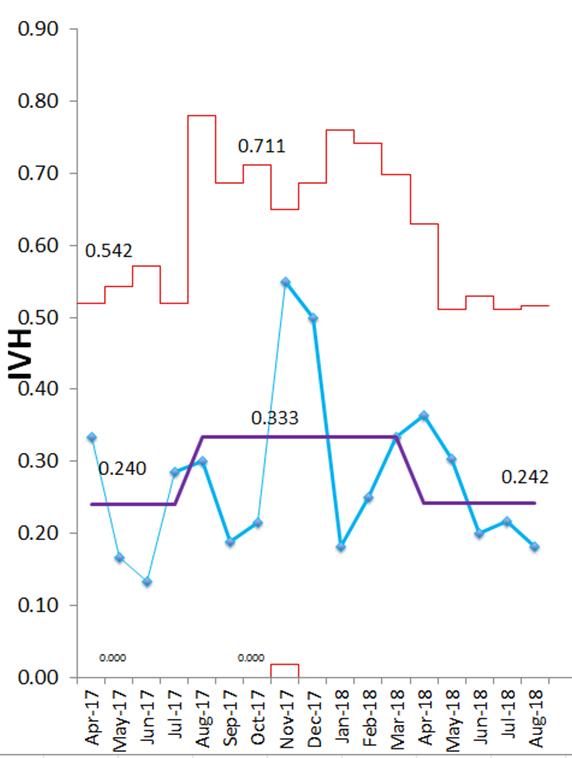
Despite the multifactorial etiology of IVH, Ramani said, standardizing the neuroprotective care is reducing the overall rate of IVH in preterm infants (Figure 1).

Figure 1           Rate of IVH Before and After NeuroNICU B.R.A.I.N. Program

Neonatology Care Protocols Chart

Arrow indicates NeuroNICU roll out

Managing Neurologic Disorders
Visit www.uab.edu/medicine/peds/patient-care/neuro-related-programs-centers to learn about the Division of Pediatric Neurology’s subspecialty clinics at the University of Alabama at Birmingham.