Browsing Tag

epilepsy

Neurology & Neurosurgery

New MEG at UAB to enhance neuroimaging possibilities 

A new magnetoencephalography could improve treatment of multiple brain diseases at UAB and Children’s. (Photo by Andrea Mabry)

By Katherine Gaither, UAB

The complexity of the human brain has long been an enigma that neuroscientists have sought to untangle. Now, new technology at UAB will act as a critical tool to help researchers and clinicians interpret the brain in unprecedented ways.

UAB has recently invested in a new MEG, which stands for magnetoencephalography. It is used on pediatric and adult patients, so it benefits patients at both UAB and Children’s of Alabama. Put simply, MEG technology measures the magnetic fields that come from the brain’s nerve cells in an effort to analyze their function—and does so at millisecond intervals.

These implications are significant not only for localizing abnormalities in the brain in patients with diseases like epilepsy but also for studying how the brain performs normal functions like speaking, hearing, and seeing.

“It’s not invasive,” said Ismail Mohamed, M.D., professor in the UAB Division of Pediatric Neurology, Department of Pediatrics. “You don’t have to put electrodes in the brain, and it has no risks. You can potentially measure brain activity across multiple sessions. You can potentially measure them across a lifetime span. You can use it to learn things about how our brain functions.”

Measuring the brain’s magnetic fields

UAB was among the first medical centers in the country to obtain a MEG, having done so originally in 2001; however, evolving technology has created a need for replacing the old technology with a new one. The new machine was installed in September 2024.

Many are familiar with MRI as a form of imaging to interpret brain activity; however, having a MEG is not as common. UAB is one of fewer than 30 clinical centers in the nation that houses this technology.

“MRI looks at structure, but MEG primarily looks at the brain waves itself,” Mohamed explained.

The machine operates in a sealed room with a thick door, which eliminates outside magnetic noise. Patients lie or sit still during the scan, which takes precise magnetic field measurements of brain activity.

“The experience is not much different from laying inside an MRI scanner; however, the technology is quite different, and the way we measure is quite different,” Mohamed said. “It’s a passive measurement, which means that even if you’re pregnant, for example, you still can get a MEG scan. There are no risks.”

Compared to MRI and other brain scans like PET, and SPECT, the MEG gives you unique information about the brain as it tracks the activity of the nerve cells. EEG scans are similar, but the MEG has a heightened ability to localize this activity.

“A traditional EEG uses 25 electrodes. The MEG has 306 sensors,” Mohamed said. “So that coverage of the brain is bigger, it enhances the potential to produce more accurate information.”

According to Benjamin Cox, M.D., assistant professor in the UAB Department of Neurology, the difference is also electric vs. magnetic.

“The electrical fields that EEGs are recording are very much attenuated by the skull and all the intervening tissues,” Cox said. “The magnetic fields are not. So, we get a lot more precise localization with the MEG.”

Clinical implications

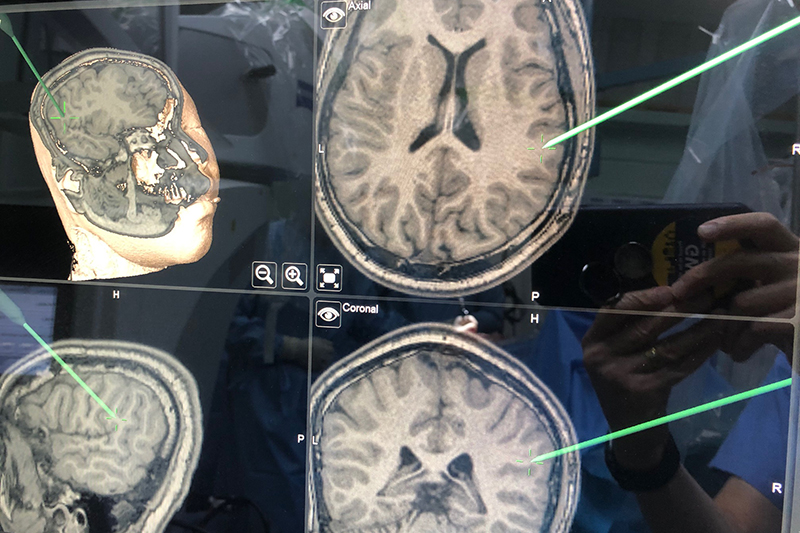
One significant implementation of the MEG is for use in epilepsy surgery to determine where in the brain seizures originate. Surgeons can use the results of a MEG scan to plan epilepsy surgeries.

“When we’re doing epilepsy surgery and trying to figure out if patients are a surgery candidate, we need to know exactly where the seizures are coming from as precisely as possible, and many times we end up putting electrodes in the brain to sample that activity directly,” Cox said. “So having studies like MEG, where we can have a precise idea of where to put those electrodes, is very helpful.”

Kristen Riley, M.D., professor in the UAB Department of Neurosurgery, notes that “MEG studies help us as surgeons to localize seizure onset zones, directing us to areas to implant monitoring electrodes. Often these areas look completely normal on MRI, but are identified by the MEG study as possible sites of seizure onset.”

A second clinical implementation involves functional brain mapping—to localize areas important for language, sensory and motor function.

“It has huge implications for learning, like child development,” Mohamed said. “Learning new languages. Processing information as the child grows. It also has a lot of potential research use for the prediction of disease outcomes. Studying things like dementia or Alzheimer’s disease.”

Cox added that the new MEG’s presence within UAB Hospital creates advantages for patients and clinicians when used as an inpatient procedure instead of an outpatient procedure, as it has been in the past.

“Epilepsy patients are on seizure medicines on a day-to-day basis to prevent seizures from happening,” Cox said. “When we bring them into the hospital and evaluate them for surgery, we get them off of their medicines, which increases epileptic activity in the brain, so it will hopefully increase the likelihood we record epileptic activity during the MEG scan.”

Studying epilepsy less invasively

From a research perspective, Rachel Smith, Ph.D., assistant professor in the UAB Department of Electrical and Computer Engineering, had been using the existing MEG to validate methods that she has been developing for intracranial EEG in epilepsy patients through a project funded by CURE Epilepsy.

“We’re electrically stimulating a given brain region and then looking for responses in the rest of the brain,” Smith explained. “That is helping us build these unique brain networks. So, we know if we stimulated in one region and see a response in another region, that means that those two regions are likely functionally or anatomically connected in some way.”

Smith and her team are then using MEG data to build computer models that can hopefully test neurophysiological signals virtually to localize epileptic seizures—and therefore less invasively.

“We’re actually saying, let’s build a network from MEG data and see if we can do a virtual stimulation where we actually just stimulate in the computer model and not in real life and see if we can get the same clinical information out,” Smith added.

The new MEG will be a useful tool for advancing research into the future; however, researchers are already realizing significant research implications with the new technology.

“It’s going to be really helpful and translational for a lot of patients right now,” Smith said. “I think being one of 27 centers across the U.S. that has access to this in our hospital is a huge opportunity for people here at UAB to take advantage of. We’re really excited.”
Neurology & Neurosurgery

Procedure and device offer new options for epilepsy patients

Curtis Rozzelle, M.D., performing a deep brain stimulation procedure for epilepsy.

In January 2024, a University of Alabama at Birmingham (UAB) pediatric neurosurgeon performed the first deep brain stimulation (DBS) procedure for epilepsy at Children’s of Alabama, offering a new treatment option for pediatric patients who experience drug-resistant seizures.

During the procedure, Curtis J. Rozzelle, M.D., a professor in the UAB Department of Neurosurgery, also implanted the first NeuroPace responsive neurostimulation (RNS) epilepsy treatment device at Children’s.

The NeuroPace RNS ® System, which consists of a small generator attached by leads to electrodes, was designed to communicate with a computer to record brain activity, recognize seizure-related patterns and deliver stimulation to suppress seizures. The device, which is curved for better placement within the skull, monitors brainwaves constantly and can be customized on a patient-by-patient basis.

“Much like a cardiac pacemaker that senses and responds to abnormal heart rhythms, this combination of technologies will detect brain activity that precedes seizures, then stimulate pathways deep in the brain to either prevent seizures from starting or stop seizure activity in its tracks,” Rozzelle said.

When performing a DBS procedure, a neurosurgeon inserts electrodes connected to a neurostimulator into the brain to disrupt epileptic electrical activity before it can cause a seizure. Similar to the RNS System, the DBS neuromodulation device can be programmed after placement in an outpatient clinic by an epilepsy specialist, like UAB Department of Pediatrics Division of Neurology professor Monisha Goyal, M.D.

In this case, Rozzelle placed the RNS® System electrodes in the thalamus, resulting in a twofold RNS and DBS procedure. 

Neurostimulators have long been used to treat various neurological disorders when traditional treatment options fail. DBS was originally developed in 1997 to treat Parkinson’s disease and has since expanded as a treatment option for epilepsy, dystonia and more. RNS gained initial FDA approval in 2013 and has proved to be effective in many patients. Presently, RNS is FDA-approved only for adults, but is successfully being used off label in the pediatric population.

Though DBS and RNS are not viable options for all patients, they show tremendous potential in treating children with epilepsy who need more innovative treatment options. “With this first RNS implantation [at Children’s of Alabama], we have expanded the armamentarium of therapies available to individuals with poorly controlled epilepsy,” Goyal said. “Unfortunately, neuromodulation with RNS is only [FDA-approved] for individuals who are at least 18 years old. The pediatric epilepsy team at Children’s of Alabama hopes that this therapy will be available to more children of Alabama soon.”

Neurology & Neurosurgery

A new procedure for epilepsy patients in Vietnam

Children’s of Alabama director of neurophysiology Trei King with a Vietnamese EEG team during a trip to Vietnam in September 2023. (Submitted photo)

With the waning of the COVID-19 pandemic, a team of neurosurgeons from Children’s of Alabama, Johns Hopkins All Children’s Hospital and Nationwide Children’s Hospital in Columbus, Ohio, were finally able to fly the 9,000 miles back to Vietnam in 2023 to continue training surgeons on surgical techniques to manage drug-resistant epilepsy.

Children’s of Alabama’s relationship with Vietnamese neurosurgeons began in 2013 with an initial visit to a team in Ho Chi Minh City. Until the pandemic hit, the team, including pediatric neurosurgeon Brandon Rocque, M.D., pediatric epilepsy surgery director Pongkiat Kankirawatana, M.D., and director of neurophysiology Trei King, BA, R.EEG.T, CNIM, visited annually to provide hands-on training at hospitals in Hanoi and Ho Chi Minh City.

Their efforts are desperately needed in a country with just two adult and two pediatric neurosurgery training programs for its 95 million people and only six pediatric neurosurgeons serving a population of more than 50 million in the northern part of the country.

“Vietnam did a very good job of managing COVID, with an extremely low per capita death rate,” Rocque said. Nonetheless, there were significant disruptions to medical care and training during lockdowns.

On their return trip to Vietnam in September 2023, the team assisted surgeons in Ho Chi Minh City with epilepsy resection surgeries. Since the Children’s team left, the local surgeons have completed at least two of these procedures on their own, albeit with some long-distance help from the Children’s surgeons. “They called us in the middle of the night, and we helped them troubleshoot the equipment a bit for the epilepsy monitoring,” Rocque said. 

On the same trip, at the National Children’s Hospital in Hanoi, the team performed the country’s first subdural grid electrode implantation, a procedure designed to pinpoint where seizures are occurring. “Everything went really well,” Rocque said. “We monitored the patients for a couple of days and were able to clearly localize where their seizures were.” Then, they removed the electrodes and performed the resection.

The procedure had never been performed in Vietnam because of concerns about infection from the temporary electrodes and the need to keep patients heavily sedated. However, those concerns were overcome when the hospital adopted international standards for the procedure.

The grid implantation, performed in two pediatric patients, received national media coverage, triggering requests from families throughout the country. “It opens up the possibility of many more patients getting treated,” Rocque said.

The team also visited the National Cancer Hospital in Hanoi to assist with an established program using selective dorsal rhizotomy to reduce spasticity in the legs from cerebral palsy. They helped evaluate patients, assisted with surgery and participated in a symposium on the procedure attended by more than 50 physicians throughout Vietnam.

The team also assisted the Vietnamese neurosurgeons in performing extraoperative video-electrocorticogram monitoring.

Neurology & Neurosurgery

LITT Device Makes Epilepsy Surgery More Precise, Less Invasive

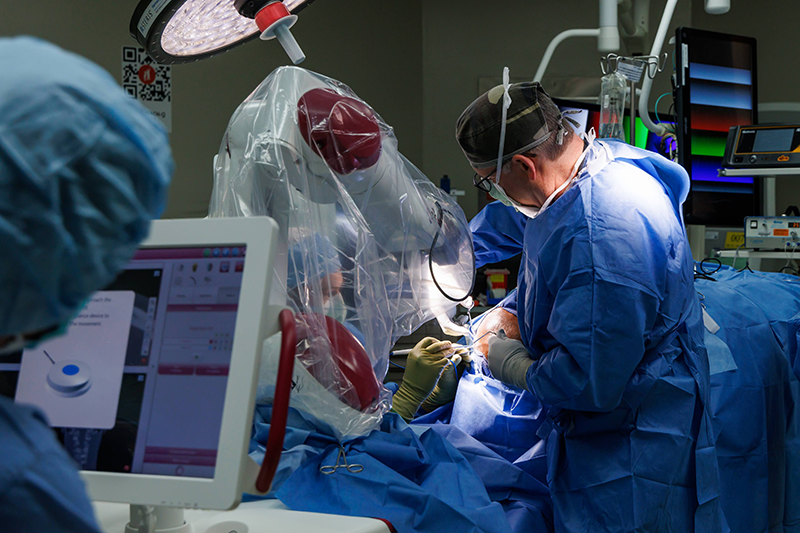
Surgeons perform a laser interstitial thermal therapy (LITT) procedure at Children’s of Alabama.

A new procedure called laser interstitial thermal therapy (LITT) allows Children’s of Alabama surgeons to take a minimally invasive approach to brain surgery and target tissue for ablation with greater precision.

Usually, patients with drug-resistant epilepsy who experience intractable seizures undergo resective surgery, in which a surgeon removes part of the brain. The procedure is very invasive, however, entailing a craniotomy, or removing part of the skull and cutting through the dura, which covers the brain. Some areas of the brain are difficult to navigate, and removing certain sections, such as the eloquent cortex, can lead to a loss of important functions, such as sensory processing or speech. Resective surgery also requires several days in the hospital and carries a risk of infection and bleeding.

“The small LITT device enables us to get into a deep region of the brain easily and safely,” pediatric neurologist Kathryn Lalor, M.D., said. “We can find the seizure onset with the electrode and then target the same area with LITT.”

The robotic system inserts a 2-to-3-millimeter probe (about the size of the tip on a new crayon) through a hole drilled into the skull. MRI guidance precisely locates the target area responsible for seizures. Once the probe is in place, a burst of laser energy destroys the tissue.

The device was initially FDA approved for temporal and medial structures in the brain, where much of adult epilepsy surgery occurs. Now, Children’s and other pediatric centers are demonstrating its effectiveness at treating epilepsy in other areas of the brain. “There’s a lot of research on how to make the energy delivery even more specific, so no unintended areas are affected,” Lalor said.

Using the device also reduces brain swelling thanks to its less invasive nature. “So, the recovery time is much quicker, and many of these patients go home the next day,” she said. In fact, studies find few complications and a good safety record.

In 2022, the team completed six surgeries using the LITT system.

Neurology & Neurosurgery

RNS Device Can Reduce Seizures in Children with Epilepsy

Dr. Kathryn B. Lalor is a pediatric neurologist at Children’s of Alabama.

A new procedure that can reduce the number and severity of epileptic seizures in children is now available at Children’s of Alabama. The NeuroPace RNS®, or responsive neurosurgical stimulation, is a small device about the size of a matchbox. When placed inside the skull with two wires attached to the brain surface and/or inside the brain, it monitors and responds to brain signals, often short-circuiting a seizure before it begins. It’s been approved for use in adults since 2013, but with recent studies on its safety and effectiveness in children, more centers like Children’s are now offering it “off label” to patients whose seizures don’t respond to medication and/or other surgical interventions.

“It’s an adjunctive therapy, meaning we don’t do it as an initial treatment or thinking someone will necessarily be cured, although that is always our goal,” pediatric neurologist Kathryn B. Lalor, M.D., said. In a multicenter study of 17 patients under age 18, the average number of seizures fell 54.4% over the 1.7-year follow-up. Most patients also experienced less intense, shorter or less frequent seizures. One patient became seizure-free, although four showed no improvement.[1]

The device wouldn’t be a first step in managing seizures, Lalor said, because it’s surgical. “We would only undertake it if we know the seizures can’t be controlled with medications alone,” she said. It also has advantages over medications, including fewer, if any, long-term side effects. One major benefit of the device is that it seamlessly uploads data on its activity to a database clinicians can access, enabling them to track and measure seizures objectively.

“Right now, we know about seizures we witness,” Lalor said. “But there are silent seizures or ones that happen during sleep or when no one is around.” Better data enables doctors to ensure they’re treating all the seizures because even silent seizures can have an effect. With this data, she said, the team can remotely adjust the amount of stimulation the device sends and/or change a child’s medication.

While the device is still not FDA-approved for children, Lalor said more insurance companies are covering it, and a growing number of hospitals offer it with successful outcomes. There is also an ongoing multi-center trial—including the University of Alabama at Birmingham—evaluating its use in adolescents ages 12 to 17.

 “We’re excited to be able to offer this,” Lalor said. The team hopes to implant the first device early this year.


[1] Nagahama Y, et al. Real-World Preliminary Experience With Responsive Neurostimulation in Pediatric Epilepsy: A Multicenter Retrospective Observational Study. Neurosurgery. 2020;39(6):997-1004.

Inside Pediatrics, Neurology & Neurosurgery

Epilepsy Transition Clinic Helps Adolescents Move to Adult Care 

At right, Kathryn Lalor, M.D., is a pediatric neurologist at Children’s of Alabama and an assistant professor in the Division of Neurology in the University of Alabama at Birmingham Department of Pediatrics. At left is epilepsy specialist Quynh Vo, M.D., of the University of Alabama at Birmingham.

At right, Kathryn Lalor, M.D., is a pediatric neurologist at Children’s of Alabama and an assistant professor in the Division of Neurology in the University of Alabama at Birmingham Department of Pediatrics. At left is epilepsy specialist Quynh Vo, M.D., of the University of Alabama at Birmingham.

Adolescents are not known for self-discipline. Yet that’s exactly what teens with epilepsy need in order to avoid seizure triggers, like lack of sleep and alcohol consumption. They also must be vigilant about taking their medication. However, as young people become young adults and start to manage their care independently, “these are the hardest things to do,” said Children’s of Alabama pediatric neurologist Kathryn Lalor, M.D. 

Which is why young adulthood carries a high risk of recurrent seizures, particularly as epilepsy patients transition from pediatric to adult neurology. “Many of these patients have had epilepsy for a long time, and they’ve been diagnosed and cared for by the same neurologist for a long time. It can be very scary and disconcerting to change that, especially as you’re coping with so many other things,” Dr. Lalor said. 

Then there are the difficulties on the medical side, such as electronic medical record systems that don’t talk to each other, making transitioning between providers difficult. “We were hearing from our adult colleagues that they just didn’t have the information they needed,” Dr. Lalor said. “It was like starting over with the medical history.” 

Which is why Dr. Lalor and her team started one of the first epilepsy transition clinics in the country. “We really wanted to improve the process from a logistical and informational perspective but also help guide these patients through the process.” That’s particularly important given the impact of epilepsy on daily life. “It affects school, being able to drive, your job,” she said. “And we really wanted to be a place where we could help young adults gain their footing in their life.” 

Now when the pediatric neurologist refers the patient to the adult provider, they gather all the pertinent data and meet together with the patient. 

The young person also completes a transition-readiness assessment questionnaire, a validated tool specifically for epilepsy, to determine how ready they are to independently manage their disease. “And if there are any places where they’re still behind, still not doing things quite on their own, we set ‘homework’ goals for them for the next visit,” said Dr. Lalor. Clinic staff follow patients until they are fully managing their own care or until the staff feels they’re stable and ready to transition, at which point most patients continue with epilepsy specialist Quynh Vo, M.D., of the University of Alabama at Birmingham. 

The clinic is so busy that in December 2021, staff added a second day a month. The next step, Dr. Lalor said, is to implement national guidelines that recommend beginning transition at age 12 and add case management and social workers to the team.  

Inside Pediatrics, Neurology & Neurosurgery

License Plates and Safer Schools: Advocacy in Action in Epilepsy 

Kathryn Lalor, M.D., is a pediatric neurologist at Children’s of Alabama and an assistant professor in the Division of Neurology in the University of Alabama at Birmingham Department of Pediatrics.

Kathryn Lalor, M.D., is a pediatric neurologist at Children’s of Alabama and an assistant professor in the Division of Neurology in the University of Alabama at Birmingham Department of Pediatrics.

When you think about epilepsy and Children’s of Alabama, you think about the epilepsy clinic, groundbreaking research, and state-of-the-art treatments and surgeries. You probably don’t think about license plates and training school staff to give life-saving emergency treatments. Yet that’s just what the pediatric neurology division has been doing as part of its advocacy efforts in the epilepsy field.  

Together with the Epilepsy Foundation AlabamaChildren’s of Alabama pediatric neurologists Monisha Goyal, M.D., Kathryn Lalor, M.D., and other staff designed the first epilepsy license plate in the country. The state approved the “Help End Epilepsy” car tag in March 2020, but it couldn’t be produced until at least 1,000 people committed to buying it. The team hit that milestone in 2021 thanks to the help of a generous donation that made the first 1,000 tags free.

“That was a big, big deal,” Dr. Lalor said. Each plate costs $50, $41.25 of which goes to the pediatric epilepsy program at Children’s. “We want to use some of that money to help educate future epilepsy specialists,” she said, citing a shortage of specialists in the region. In fact, while Children’s has a fellowship slot in epilepsy, it hasn’t had the funding to fill it.

The second major advocacy effort in 2021 revolved around improving the school environment for children with epilepsy by training school personnel other than nurses to administer seizure-rescue medications. That’s important for the 7,500 Alabama students with epilepsy. If there isn’t a nurse nearby, they can’t participate in activities like sports and field trips. Yet just 70 to 75 percent of Alabama public schools have access to a nurse, often sharing that nurse among several schools. 

Dr. Lalor and her colleagues, along with the Epilepsy Foundation Alabama, lobbied state legislators to pass the Seizure Safe Schools Act, including testifying in front of the House and Senate committees.  

It wasn’t as easy as they expected it to be, with opposition coming from the school nurses association and some legislators concerned that allowing non-medical volunteers to administer emergency medicine would hinder efforts to hire more nurses. That was never the intention, Dr. Lalor said. “We would love for school nurses to be everywhere,” she said. “The school systems just can’t afford that.” And there’s a national shortage of school nurses. Nonetheless, the legislature added an amendment to the act calling for more efforts to put school nurses in every school. “We fully support this,” said Dr. Lalor. “This is crucial for the safety of students.” 

A statewide task force composed of Epilepsy Foundation and Children’s representatives, school nurses, and public health officials is working to implement the new law and hopes to roll out education in early spring 2022. 

Inside Pediatrics, Neurology & Neurosurgery

Children’s of Alabama Clinicians Bring Expertise and Training to Vietnam

Global Surgery NEW_WEB

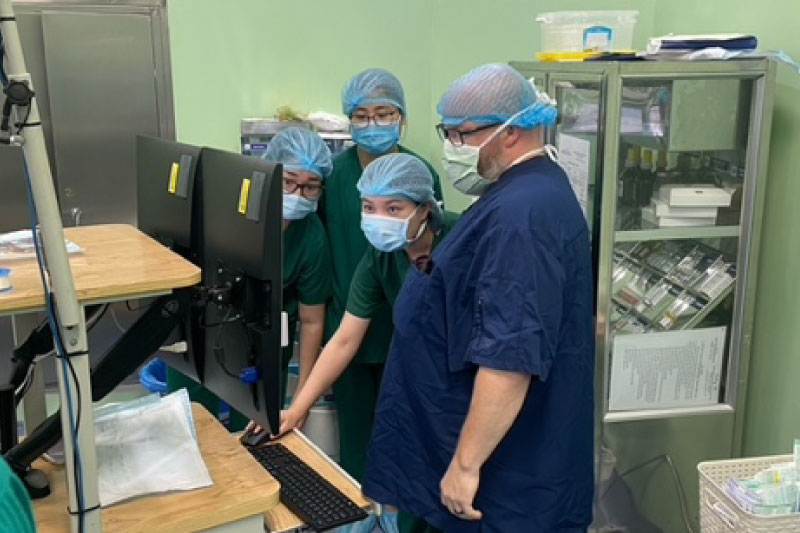
Children’s of Alabama physicians review a brain scan at a hospital in Vietnam. Neurosurgeons, neurologists and other medical staff travel to Vietnam at least once a year to provide lectures and hands-on training at hospitals in Hanoi and Ho Chi Minh City as part of Children’s of Alabama’s Global Surgery Program.

Surgical interventions to reduce the burden of drug-resistant epilepsy in children have become an integral part of the field in the past 20 years. In low- or middle-income countries like Vietnam, however, it typically remains a vision, not a reality. Vietnam, for instance, has just two adult and two pediatric neurosurgery training programs for a country of 95 million people, and just four pediatric neurosurgeons serving a population of more than 50 million in the northern part of the country.

Enter Children’s of Alabama’s Global Surgery Program, which is designed to form strong, collaborative relationships with large pediatric hospitals in low- and middle-income countries and provide subspecialty fellowship training at Children’s. The hospital’s relationship with Vietnam began in 2013, with an initial visit to neurosurgeons in Ho Chi Minh City. Since then, a team from Children’s, including pediatric neurosurgeon Brandon Rocque, M.D., MS, FAANS, Pediatric Epilepsy Surgery Director Pongkiat Kankirawatana, M.D., Clinical Neurophysiology and Pediatric Epilepsy Program Director Monisha Goyal, M.D., and Director of Neuromonitoring Trei King, R.EEG.T, C.N.I.M., among others, has traveled the nearly 9,000 miles to Vietnam at least once a year to provide lectures and hands-on training at hospitals in Hanoi and Ho Chi Minh City. Their efforts have helped create premier epilepsy programs that draw children from throughout southeast Asia.

“We started with the corpus callosotomy,” Rocque said, a procedure performed on children with generalized epilepsy prone to drop attacks. It involves splitting the main connection pathway between the two cerebral hemispheres to prevent the attacks. The Vietnamese team, led by a neurosurgeon who specialized in brain tumors, performed two such surgeries with the Children’s of Alabama neurosurgeons, then went on to complete 10 themselves over the next six months, all with good long-term results.

Epilepsy surgery is not possible without advanced EEG monitoring, which is where King came in. His job was to teach EEG technologists how to use an EEG in the operating room, including electrode placements, and the most appropriate test for the child’s condition. “We started with the basics and now we’re going much deeper,” he said.

“The people there are extremely hard working and very, very smart,” King said. “They just didn’t have the opportunity and education. The training with our staff allows them to see the entire gamut of what we do in the field and, hopefully, grow to do what we do.”

The Children’s of Alabama team usually spends a week in each city, giving lectures and assisting with the more complex surgeries. “We’re not trying to hammer out a bunch of cases,” Rocque stressed. “The model is not missionary surgery; it’s teaching and working on the patients they asked us to assist with in order to reach a goal of improving specific techniques for the neurologists and surgeons.”

In addition to building the team’s skills in epilepsy surgery, the team hopes to improve how pediatric neurosurgeons are trained in Vietnam, Rocque said. Currently, residents are trained in neurosurgery but don’t receive any formal pediatric training. “There is a really big opportunity to improve the way pediatric neurosurgery is taught in this region,” Rocque said. To help in that goal, Vietnamese physicians and EEG nurses now come to Alabama for several months for focused training on various procedures.

The partnership has continued to grow, with the Vietnamese doctors sending PowerPoint presentations on difficult cases for discussion at Children’s of Alabama’s weekly multidisciplinary meeting, during which the neurology team develops treatment plans. Now the team also discusses the Vietnamese patients. “When we started, we often had to ask for more information and make some changes to the treatment plan,” Rocque said. “But over the last year, their own recommendations have been spot on.”

The experience has been eye opening for the Children’s of Alabama clinicians. “I found a pediatric neurology and neurosurgery program making a valiant effort in diagnosing and treating one child after another with minimal resources,” said Goyal, who visited City Children’s Hospital in Ho Chi Minh City. The children slept on cots that spilled out into the adjacent roofed but open courtyards and hallways, she said. “There were no fans and in September temperatures in Ho Chi Minh were far from balmy.” She was also struck by the fact that the government does not allow the use of benzodiazepines, one of the most common medications used to control seizures in the U.S.

However, Goyal said, “the small number of clinicians do an admirable job with limited resources. They learn from textbooks, not from mentors, even though they have much fewer technical and pharmacological resources.”

“As a physician, this has been a very rewarding experience,” Goyal said. She, Rocque and King are planning another trip this spring to Ho Chi Minh City to continue helping the hospital develop of its own pediatric surgical epilepsy program.

King echoed Goyal’s comments. “It’s been one of the most rewarding things I’ve experienced in my career,” he said. “You see the big difference you make not only in the training, but in the impact on the patients receiving care that they would not get unless we’re there.”

“The patients and families are so appreciative,” King said. “I’ve never experienced that level of appreciation before. I think a lot of it has to do with realizing that without the partnership and collaboration we wouldn’t be able to do the surgeries.”

For instance, he recalls one family whose child was operated on returning to the hospital a year later with a picture of the child to express their thanks. “Those are the things they make this so rewarding,” he said. “When we see the difference it makes in the life of the patients and families and the joy that continues long after the surgery.”