
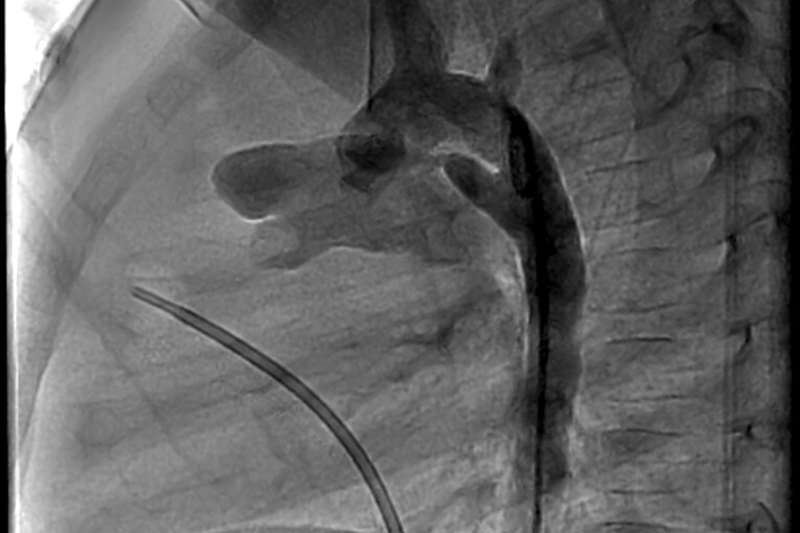
An X-ray shows a patent ductus arteriosus. (File photo)
By Maureen Salamon
Doctors have long debated whether very premature babies with patent ductus arteriosus (PDA)—a cardiac condition where a blood vessel that normally closes shortly after birth remains open, stressing the heart and lungs—should be immediately treated with medication to close the vessel, or whether it’s better to wait and see if the vessel closes on its own.
Compelling new research by Children’s of Alabama neonatologist Waldemar A. Carlo, M.D., reveals important answers. Along with researchers from 32 other hospitals across the United States, Carlo sought to learn whether simply monitoring infants and intervening only if needed, compared with actively treating PDA, improves survival or reduces serious lung problems.
Results of the study, published last December in JAMA, surprised even Carlo. Monitoring infants and intervening only if needed, rather than treating the PDA up front, improved survival or serious lung problems—the main outcome—with the rate of developing bronchopulmonary dysplasia (a serious chronic lung disease) essentially the same in both groups. Notably, however, babies in the watch-and-wait group were significantly more likely to survive: 4.1% of infants in the expectant management group died, compared to 9.6% of those in the medication treatment group.

“I don’t think anyone was expecting to see such a large difference in mortality,” said Carlo, who’s also the Edwin M. Dixon Professor of Pediatrics and director of the Division of Neonatology at the University of Alabama at Birmingham (UAB).
PDA is the most common cardiovascular condition in preterm infants, and Children’s clinicians monitor or treat about 100 babies with the condition each year. Occurrence of PDA jumps to more than 50% for extremely premature infants such as the 482 included in the study, who were all born between 22 and 28 weeks of pregnancy.
“PDA tends to be present in the sickest premature babies with the worst outcomes, which is why there has been a lot of interest in closing the PDA,” Carlo says. “But the data have been controversial on whether these babies need treatment or not.”
A small PDA might cause no symptoms and resolve on its own. Larger ones can lead to a variety of dangerous complications, including rapid breathing or shortness of breath, poor feeding, failure to thrive, fatigue, and frequent respiratory infections. In the study, which was carried out as part of the National Institute of Child Health and Human Development Neonatal Research Network, expectant management proved superior to all medications or other approaches used in babies randomly assigned to active treatment, including acetaminophen, ibuprofen, or indomethacin as well as surgery.
“Treatment to close the patent occurred in both groups, which is mimicked in clinical practice,” Carlo said, “and none of the treatments really had a benefit. The study design was pragmatic and easy to implement. It can help clinicians in a practical way.”
The trial reinforced how neonatologists at Children’s have long managed PDA, Carlo noted, but participating in such a high-profile, comprehensive effort benefits everyone involved.
“Our patients can take advantage of state-of-the-art care through randomized, clinical trials and innovative inventions. The trial is funded by the government, and the government benefits because we find out what are the right treatments in these patients,” Carlo said. “It’s a win-win situation.”

No Comments